
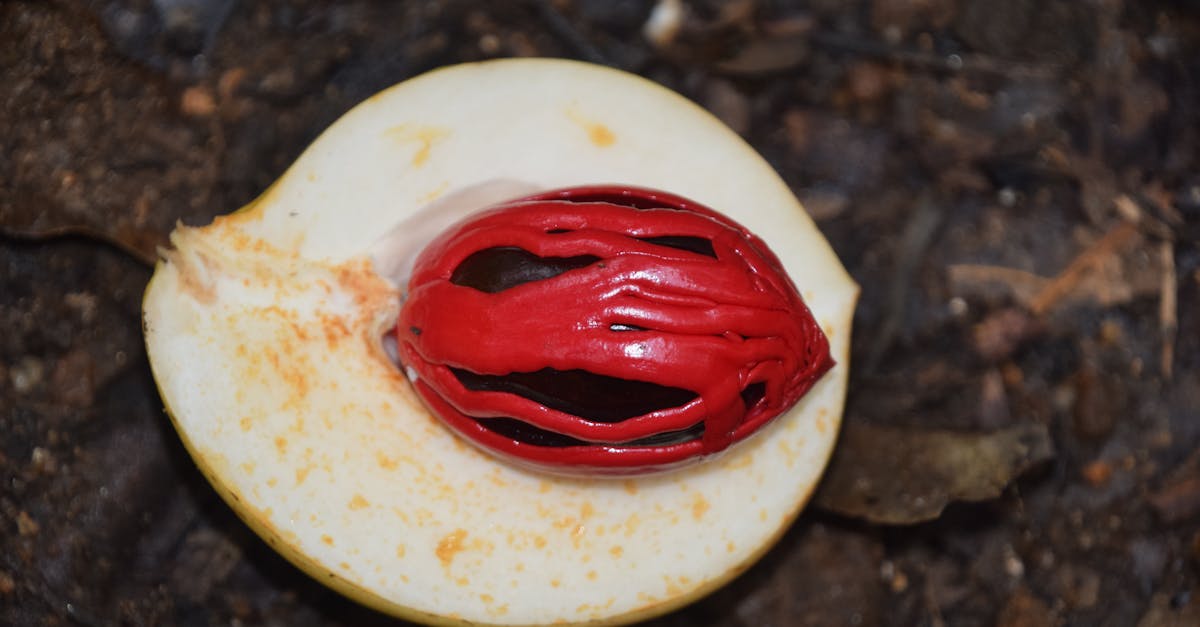
Nutmeg and mace are a realistic tree-spice crop in India only in the humid, shaded belts of Kerala, coastal Karnataka, Tamil Nadu, Goa, Maharashtra's Konkan and the Andamans, and they take years of patience: TNAU puts the first harvest 6 to 7 years after planting, and ICAR projects a good tree at about 2,000 fruits only by year 15. Kerala grows nearly all of India's nutmeg, usually as a shade tree mixed with coconut, arecanut or other plantation crops.
One fruit gives two spices: the brown seed kernel is nutmeg (jaiphal) and the red net around it is mace (javitri). Trees are male or female, and only female or bisexual trees bear fruit, so the choice of planting material matters more than any other decision. Prices in this guide were reported in September 2026 and move with exports, so confirm them at Cochin before planning.
Where it grows in India
- Area and states: ICAR reports about 23,478 ha and 15,076 tonnes of nutmeg in Goa, Karnataka, Kerala, Maharashtra, Tamil Nadu and Andaman and Nicobar. NIFTEM, citing National Horticulture Board data for 2015-16, puts Kerala at 98.13% of production and Karnataka at 1.38%.
- Climate: warm, humid, with 150 to 250 cm of rain a year, from sea level to about 1,000 m (TNAU) or 1,300 m (ICAR). Dry climates and waterlogging do not suit it. Riverbanks and sheltered valleys are best.
- Soil: friable, well-drained clay loam, sandy loam, red or laterite soil.
- Shade: medium shade, especially when young; fast-growing shade trees or banana are used. At higher elevations it can grow without shade.
Varieties and planting material
| Variety | Source | Traits | Suited to |
|---|---|---|---|
| IISR Viswashree | ICAR-IISR, Kozhikode | High-yielding selection; reported about 1,000 fruits per tree by the 8th year; dry recovery about 70% for nut and 35% for mace | Kerala and similar humid tropics |
| KAU Punnathanam | Kerala Agricultural University | Bushy, compact, low fruit rot; nut 13.85 g and mace 3.02 g per fruit | Throughout Kerala |
| KAU Pullan | Kerala Agricultural University | Conical erect canopy; oval nut; nut 10.85 g, mace 1.36 g | Throughout Kerala |
| KAU Kochukudy | Kerala Agricultural University | Conical spreading canopy; nut 11.6 g, mace 2.49 g | Thrissur district |
| KAU Mundathanam | Kerala Agricultural University | Dark red mace; nut 12.6 g, mace 2.49 g | Palakkad district |
| KAU Poothara | Kerala Agricultural University | Dark red mace; nut 10.0 g, mace 2.06 g | Kottayam district |
| Konkan Swad, Konkan Sugandha | Regional Coconut Research Station, Bhatye, Ratnagiri (Konkan) | Listed in the TNAU package of practices; ask the station for current traits and graft availability | Konkan coast, Maharashtra |
- Nutmeg is dioecious and seed-grown trees split about half male, half female, so seed planting is not in vogue. Plant grafts or buds: epicotyl grafts from Viswashree or other proven female mother trees, or patch-budded plants.
- Male trees are still needed for pollination because the crop cross-pollinates. A common recommendation is about one male for every ten females; ask the nursery which grafts are male and mark them.
- Rootstock seedlings come from naturally split ripe fruits collected in June and July and sown at once. Seedlings are ready to transplant after 18 to 24 months (TNAU).
- Buy grafts only from an ICAR-IISR, KAU, state horticulture department or Spices Board accredited nursery, with a written note of the mother tree.
Spacing and planting
- Standard trees: TNAU gives 8 m x 8 m in 60 cm cubic pits, about 63 trees per acre (156 per hectare). Seedling trees were traditionally set at 9 m x 9 m.
- Bush type: grafts from side (plagiotropic) shoots grow bushy, and ICAR-IISR planted them at 5 m x 5 m, or even 2 m x 2 m for pruned bush nutmeg that gave 100 to 150 fruits per tree per year. Field yields of full trees are much higher.
- Plant in the rains with shade ready. In coconut or arecanut gardens, keep the nutmeg at the recommended distance from the main crop.
Nutrition and irrigation
- Year 1 (TNAU): 20 g N, 20 g P and 60 g K per tree plus 15 kg farmyard manure.
- Established trees (TNAU): 300 g N, 300 g P and 960 g K plus 50 kg farmyard manure per tree a year, split between June to July and September to October. That is about 19 kg N, 19 kg P and 60 kg K per acre at 63 trees (47, 47 and 150 kg per hectare at 156 trees). Add 50 g each of Azospirillum and Phosphobacterium a month after manuring.
- Doses rise gradually between year 1 and the full dose; follow your soil test and see fertilizers for forms of N, P and K.
- Irrigation: once in 5 to 7 days in summer. Drip saves water in dry months.
Pests and diseases
- Anthracnose (Colletotrichum): the most serious disease in Kerala, seen all year. It causes brown spots with a yellow halo on leaves, shoot die-back and sunken black spots on fruit, and half-grown fruits rot and drop. KAU advises removing and burning fallen leaves and fruit, correct spacing and shade, monthly Pseudomonas fluorescens (20 g per litre) from monsoon onset, Trichoderma-enriched cow dung at 5 to 10 kg per tree, and copper oxychloride 50 WP at 2 g per litre where needed.
- Loranthus (parasitic plant): cut it out and paint the cut with Bordeaux paste (TNAU).
- For any chemical, follow the label and ask your KVK, since mace and nutmeg are eaten and buyers test for residues. See pests.
Harvest, processing and yield
- Bearing: TNAU says harvest starts 6 to 7 years after planting; seedling trees flower between 4 and 7 years but half are unproductive males. ICAR projects a good 15-year-old tree at about 2,000 fruits.
- Yield: TNAU gives 1,000 to 2,000 fruits per tree, equal to 5 to 7 kg of dried nuts and 0.5 to 0.7 kg of dried mace per tree. IISR reports Viswashree at about 1,000 fruits in the 8th year.
- Harvest: fruits ripen in 6 to 8 months and split on the tree. NIFTEM advises preferring freshly picked fruit to fallen fruit for quality.
- Processing: separate the mace from the seed and dry mace at once to prevent mould. NIFTEM advises blanching in hot water with 100 ppm chlorine or 1,000 ppm alum before drying, and drying seeds at 40 to 50 °C to protect oil content; sun drying takes 4 to 8 weeks.
- Quality (FSSAI): moisture not more than 10% for nutmeg and mace; volatile oil not less than 6.5% in nutmeg and 7.5% in mace.
- The fleshy rind is usable for jam, candy and pickle, adding a small extra income.
Cost and returns
- Price (September 2026): the Commodity Board report of 3 September 2026, quoting Spices Board data, gave Cochin nutmeg at ₹320 per kg with shell and ₹595 per kg without shell on 1 September 2026. A mace price could not be confirmed, so check the daily Spices Board Cochin quote or the nearest auction before using any figure.
- Arithmetic (illustration, nutmeg only): a mature tree giving 5 to 7 kg of dried nut at ₹300 per kg is ₹1,500 to ₹2,100 a year. At 63 trees per acre that is about ₹95,000 to ₹1.3 lakh per acre (₹2.3 to ₹3.3 lakh per hectare) before mace, labour and drying. Mace at 0.5 to 0.7 kg per tree adds to this at its own price.
- These returns come only from year 8 to year 15 onward, and need female bearing trees. A stand where many trees turn out male earns far less.
- Establishment cost and subsidy rates were not verified for this guide; ask the Spices Board, your state horticulture department and the KVK for current norms, and see the subsidy finder.
Market and risks
- Buyers: spice traders and exporters at Cochin and Kerala hill markets such as Thodupuzha, plus processors for oleoresin and oil. India exported 3,812 tonnes of nutmeg and mace worth ₹19,115 lakh in 2020-21, yet also imports mace (1,910 tonnes worth ₹21,137 lakh in 2019).
- Price risk: exports of nutmeg and mace in April to June 2026 fell about 35% to roughly 704 tonnes on weak foreign demand, so prices can stay flat for long periods.
- Wet weather in monsoon raises fruit rot, and slow drying causes mould, which buyers reject; arrange shade drying or a dryer before the first crop. Join an FPO for shared drying and for selling to export buyers. See mandi bhav for current rates.
Sources
- TNAU Agritech Portal, Nutmeg crop production guide
- Kerala Agricultural University, Agri-Infotech Portal, nutmeg varieties
- Kerala Agricultural University, Agri-Infotech Portal, anthracnose of nutmeg
- Thankamani, Kandiannan and Rema, Bush nutmeg, Indian Horticulture (ICAR-IISR)
- NIFTEM, Process technology for nutmeg (area, Kerala share, drying, FSSAI standards)
- Vikaspedia, Nutmeg package of practices (IISR Viswashree)
- Commodity Board, Indian nutmeg market report, 3 September 2026 (cites Spices Board Cochin prices; secondary source)