
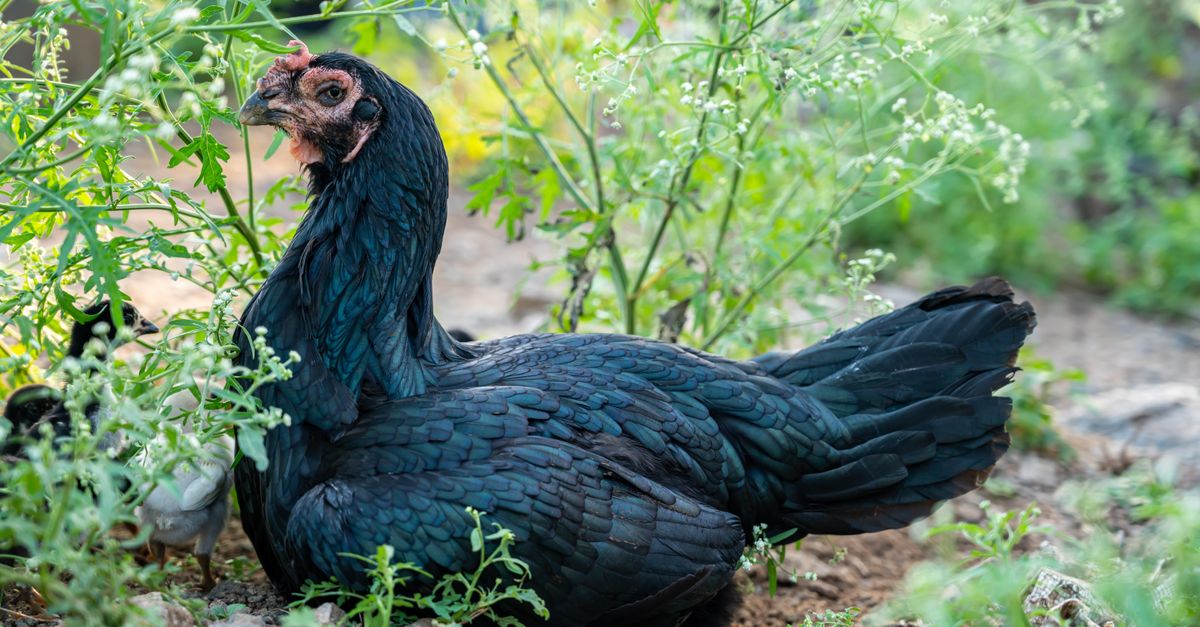
Kadaknath is a black-fleshed native chicken from Jhabua and Dhar in western Madhya Pradesh, and it can be reared anywhere in India as a small backyard or deep-litter enterprise. It earns a premium only because the meat and eggs sell far above ordinary chicken, but the bird grows slowly, lays few eggs and takes five to six months to sell, so profit depends on finding buyers who pay for genuine birds.
The breed is hardy in heat and resists many diseases in free range, but a GI application describes it as susceptible to Marek's disease under intensive rearing, so vaccination and hygiene matter.
Origin and breed traits
- Home area: Jhabua and Dhar districts of Madhya Pradesh and adjoining areas of Gujarat and Rajasthan, traditionally reared by Bhil and Bhilala tribal families.
- GI tag: "Jhabua Kadaknath Black Chicken Meat" is the registered Geographical Indication name (Class 29), applied for by Gramin Vikas Trust, Jhabua, with Jhabua, Dhar and adjoining districts as the production area. Check the registration conditions before labelling your birds as GI Kadaknath.
- Varieties: jet black, penciled and golden. Skin, beak, shanks and many internal organs are black from melanin deposition (fibromelanosis).
| Trait | Reported value |
|---|---|
| Body weight at 20 weeks | about 920 g |
| Adult cock / hen weight | 1.5 to 2 kg / 1 to 1.5 kg |
| Age at sexual maturity | about 180 days |
| Eggs per year | about 80 to 105 (the GI document gives both figures) |
| Egg weight at 40 weeks | about 49 g |
| Fertility / hatchability of fertile eggs | about 55% / 52% |
Getting stock
- Buy day-old chicks or started chicks from a recognised source such as KVK Jhabua, a state poultry or veterinary university farm or a hatchery that can show parent stock. Ask for the Marek's vaccination record.
- Pure birds are small; cross-breeds reach about 3 kg, which is why many sellers pass cross-breeds off as Kadaknath. A pure adult weighs 1 to 1.5 kg.
- Check the flesh as well as the feathers: the ICAR paper describes black skin, shanks and internal organs in all three varieties. Ask the seller for the parent stock source.
Housing, feed and health
- Housing: the ICAR-published Jabalpur trial kept chicks in a deep-litter house that was cleaned, whitewashed, disinfected, well ventilated and lit, with fresh water at all times. Keep brooding warm in the first weeks, and keep the flock dry and uncrowded.
- Feed: that trial used a broiler starter ration of 23% crude protein and 2,800 kcal/kg, then a finisher of 20% protein and 2,900 kcal/kg. Total feed per bird over 90 days was about 2.5 to 2.7 kg.
- Vaccination: TNAU's schedule lists Ranikhet (Newcastle) vaccine in the first week and Marek's vaccine on day 1 for layer chicks. Ask your veterinarian or the state animal husbandry department for a schedule for your area and follow the label.
- The GI document says the bird resists disease in free range but is more susceptible to Marek's disease under intensive rearing, so avoid crowding and buy only vaccinated chicks.
Growth and feed efficiency
- In the Jabalpur trial (Nanaji Deshmukh Veterinary Science University, 120 chicks, 90 days), unsupplemented birds weighed 672.6 g at 90 days with a feed conversion ratio of 3.98 (about 4 kg feed per kg gain). Birds fed the enzyme phytase at 1,000 IU per kg reached 913.4 g with an FCR of 2.70.
- Even the better figure is poor compared with commercial broilers, so feed is the main cost. Ask a veterinarian before using any feed additive.
💡 Tip: Start with 50 to 100 birds and a written order from at least one buyer. Sell a first batch before you build more housing.
Cost and returns
- Trial economics (90 days, per bird): total cost ₹151 to ₹157 (chick ₹50, feed ₹74 to ₹80, electricity ₹10, vaccines and medicines ₹7, management ₹10) against a sale value of ₹235 to ₹320 at the trial's valuation, which works out to about ₹350 per kg live weight. Profit was ₹78 to ₹169 per bird. Chick and feed prices have changed since that study.
- Reported selling prices: a 2024 Mongabay India report quotes meat at ₹800 to ₹1,000 per kg and eggs at ₹20 to ₹35 each in Jhabua, with birds sold after five to six months. A 1.2 kg bird at ₹800 to ₹1,000 per kg is ₹960 to ₹1,200; at ₹350 per kg it is about ₹420. Which price you receive depends on your channel.
- Arithmetic (illustration): a bird eating about 4.5 kg feed at the trial's feed rate of about ₹30 per kg costs about ₹135 in feed, plus chick, medicine and management of about ₹70 to ₹100, roughly ₹200 to ₹250 per bird to selling age. Net per bird then ranges from about ₹170 (at ₹350 per kg) to about ₹700 to ₹950 (at the reported premium price). Mortality, unsold birds and the longer grow-out reduce this.
- The Mongabay report cites a 2022 value-chain study in which 38% of farmers sold to traders and 33% directly to customers.
Market and risks
- Buyers are local consumers, traders and other farmers buying chicks. The premium exists only for genuine, black-fleshed birds, and false labelling of cross-breeds is common, so build repeat customers and be open about the birds' source.
- Eggs are small in number: at 80 to 105 per year, egg sales will not cover costs alone.
- Do not pay advance money for chicks, breeding stock or "buy-back" contracts from sellers who promise assured returns per bird.
- Ask your state animal husbandry department about poultry schemes through the subsidy finder; no Kadaknath-specific rate was verified. Pool sales through an FPO, and see KCC for working-capital credit for animal husbandry.
Sources
- Effect of phytase supplementation on production performance and economics of Kadaknath chickens, Indian Journal of Animal Sciences 91(11), 2021
- Statement of case, Jhabua Kadaknath Black Chicken Meat (Geographical Indication application)
- Mongabay India, a fowl that travelled from forests to farms (2024)
- TNAU Agritech Portal, poultry vaccination schedule