
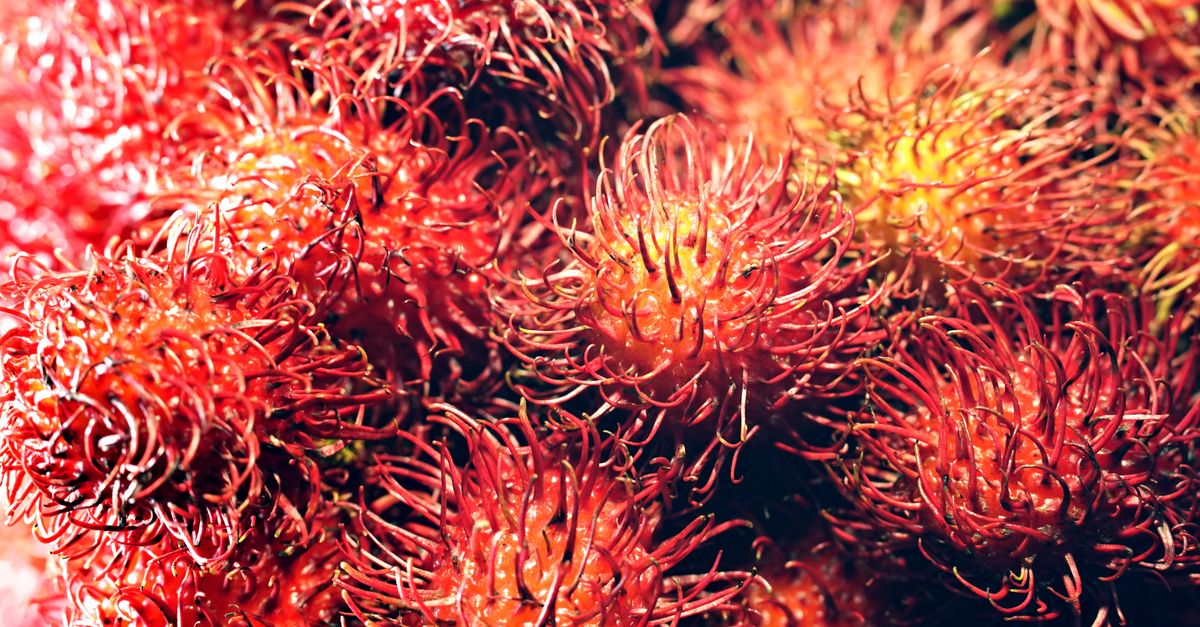
Rambutan works in India in the warm, humid, frost-free belts of Kerala (especially Pathanamthitta, Kottayam, Ernakulam, Thrissur, Idukki and Wayanad), with smaller plantings in Tamil Nadu, Karnataka (including Kodagu), Goa and the Konkan. It needs a grafted or layered plant of a known female or hermaphrodite variety, 3 years before the first fruit, and a plan to move a soft, short-lived fruit quickly to buyers. It is not a crop for dry, hot or frosty regions.
Rambutan has expanded fast in the Kerala rubber belt, which is both the opportunity and the risk: as more orchards come into bearing, the high prices of the early years may not last. The main reason to plant is that Kerala-grown fruit can reach consumers within a day or two of harvest, which imported fruit cannot match.
How big is it, and a data warning
Recent trade and news figures disagree. A FreshPlaza report of 29 June 2026 (quoting an industry executive) puts the area at 10,000 to 17,000 acres, 550,000 to 650,000 trees and 25,000 to 30,000 tonnes of production a year. An Outlook Business article of 3 August 2026 gives about 25,000 acres and roughly 1 lakh tonnes this season. These cannot both be right, so there is no reliable official count. Plan on the assumption that supply is rising quickly. Harvest in Kerala runs from May, peaks in June to August and extends into September for some varieties.
Climate and soil
Rambutan wants warm temperatures all year, no frost, and well-distributed rainfall with water available in the dry spell before flowering. It prefers deep, well-drained loamy soil rich in organic matter; waterlogged soil kills the tree. Rubber-belt hill slopes and coconut gardens of Kerala fit well. No Indian source giving a firm minimum temperature or rainfall figure was found, so check the local conditions with your KVK.
Varieties
| Variety | Source | Traits |
|---|---|---|
| Arka Coorg Arun (red) | ICAR-IIHR, Chettalli (Kodagu) | Fruit 40 to 45 g; flowers February to March; harvest September to October; 750 to 1,000 fruits per tree |
| Arka Coorg yellow variety (spelled Patib, Pitab or Peetabh in different sources) | ICAR-IIHR, Chettalli | Fruit 25 to 30 g; harvest October; 1,200 to 1,500 fruits per tree |
| N18 and other Malaysian clones (HG School Boy, HG Malwana, HG Baling, E35, King and others) | Introduced; N18 dominates commercial planting per the FreshPlaza report | Early to extended harvest windows; confirm clone identity with the nursery |
IIHR notes that a major constraint is the unavailability of true-to-type planting material. Rambutan is dioecious (separate male and female trees), and seedlings often turn out male and bear no fruit, so seed propagation is not advisable for commercial planting. Use a vegetatively propagated plant (budding, grafting or air layering) from a nursery that names its mother trees, and plant more than one cultivar to aid pollination.
Planting and spacing
Vegetatively propagated trees are planted at 8 m x 8 m or 8 m x 6 m. At 8 x 8 m that is about 63 trees per acre (156 per hectare); at 8 x 6 m about 84 per acre (208 per hectare). Dig 1 m pits, fill with topsoil, well-rotted cow dung or compost and rock phosphate, and plant at the start of the monsoon. Mulch heavily and shade young plants in the first summers.
Nutrition and irrigation
Rambutan responds to manure and fertiliser. A Sri Lankan Department of Agriculture guide advises fertiliser after a new leaf flush has emerged and hardened, with compost or cow dung around the tree. No verified Indian age-wise NPK schedule was found, so get a soil-test-based schedule from your KVK or KAU. Irrigate through the dry weeks before and during flowering and fruit set, ideally with drip, and keep water from standing around the trunk.
Pests and diseases
No verified Indian pest and disease schedule for rambutan was found. Fruit-eating birds, bats and squirrels are commonly reported in orchards, and fruit flies are a risk for any fruit crop; net or bag fruit where practical, and ask your KVK for current recommendations. See the pests page for identification help.
Harvest and yield
Trees begin bearing in about the 3rd year. Outlook Business (August 2026) reports about 30 kg per tree in year 3, 50 kg in year 4 and 70 kg in year 5, rising to as much as 300 kg for mature trees. The IIHR varieties are quoted as 750 to 1,500 fruits per tree. Rambutan is non-climacteric, so it does not ripen after picking; harvest ripe, and pick whole bunches.
Cost and returns
At 63 trees per acre and the reported 30 to 70 kg per tree in years 3 to 5, an acre gives about 1,900 to 4,400 kg. At ₹100 per kg (the price used in the Outlook example, not a verified market price), that is about ₹1.9 to 4.4 lakh per acre. A fully mature tree at 300 kg would be 18,900 kg per acre, but that is an upper figure from a news report, not a trial result. The same article quotes one farmer reporting ₹14 lakh per hectare on a year-4 harvest against about ₹60,000 expenditure; treat that as a single farmer's claim, not an expected return, since it exceeds what the yield-and-price arithmetic above supports. Years 1 to 3 carry cost (plants, drip, labour, fencing) with no fruit income, and no verified Indian cost-of-cultivation figure was found.
Market and selling
- Buyers are supermarkets, premium retailers in Kerala, Bengaluru and Chennai, e-commerce and quick-commerce platforms, and foodservice. GCC countries are the current export destination; Australia and Europe are only future potential, according to the FreshPlaza report.
- The fruit has a short shelf life and needs quick, cool transport. Outside South India consumer awareness is low, and grading, post-harvest handling and cold chain need improvement.
- Peak-season gluts are likely as more orchards fruit together; cold storage and processing help. See cold storage subsidy and FPO for group selling.
- Be cautious of nurseries promising buy-back or "₹10 lakh per acre" income, and of "rambutan" saplings sold without a variety name or a female or hermaphrodite guarantee.
Subsidy
No current MIDH or Kerala Horticulture Mission rate specifically for rambutan has been verified, so none is given. Check the subsidy finder and your district horticulture office.