
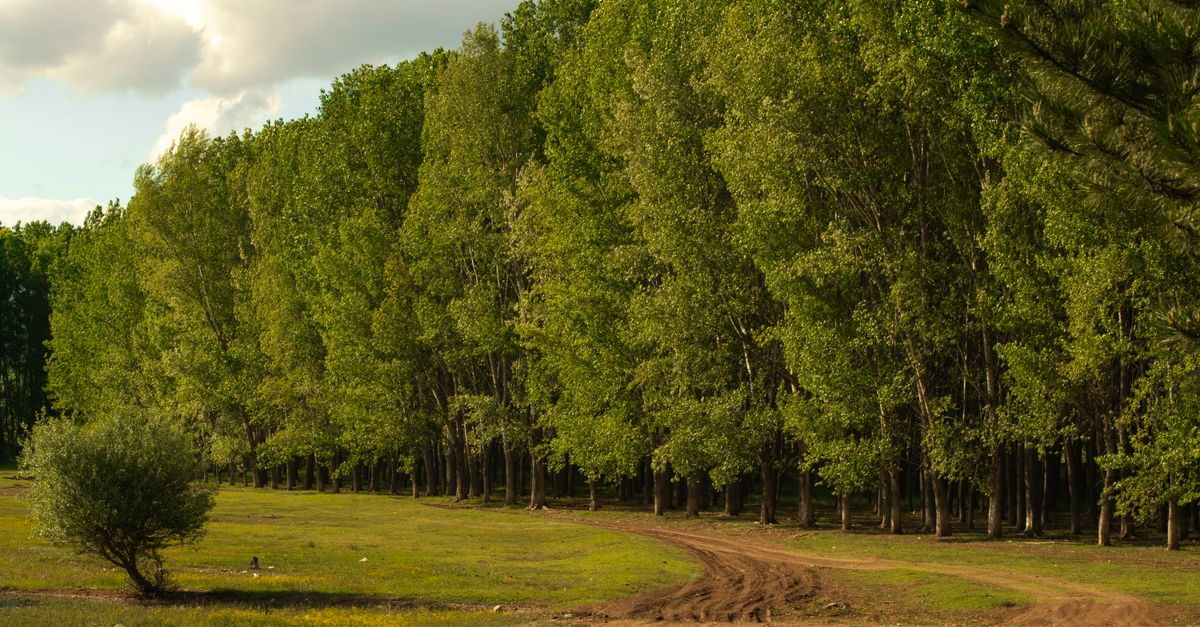
Poplar (Populus deltoides) works as a cash tree in the irrigated plains of Punjab, Haryana, western Uttar Pradesh and neighbouring states, where plywood mills such as those around Yamunanagar buy the logs and the tree's winter leaf-fall lets you grow wheat, mustard or fodder between rows. It needs good irrigated soil, planting material from a trusted nursery, and a 6 to 8 year wait for the main income.
Reported wood prices are set in the Yamunanagar and Jagadhri timber markets and swing from year to year, so plan with a low price as well as a high one.
Where it grows and what it needs
- Area: a 2026 Indian Farming article by ICAR and CCS HAU authors puts poplar agroforestry in northern India at about 263,000 hectares, with farmers in Haryana, Punjab and western Uttar Pradesh the main growers and growers also in Himachal Pradesh, Bihar and West Bengal.
- Conditions: deep, well-drained, irrigated loam to sandy loam is best. Poplar is deciduous and stays leafless for up to four months in winter, which is what makes wheat intercropping possible. Clones 63-N and 25-N outperformed others on partly reclaimed sodic land in Sultanpur district, Uttar Pradesh; do not plant ordinary clones on salty or waterlogged land.
- Row direction: north to south rows let more light reach intercrops.
Clones and planting material
| Clone | Source / note | Traits | Suited to |
|---|---|---|---|
| G-48, Udai, W-22, W-32, W-39, S7C15, S7C8 | Listed as high-yielding clones in the 2026 Indian Farming article | G-48 is the long-standing commercial clone; W-39 (WSL-39) recorded the best height and diameter among five clones in a Yamunanagar spacing trial up to 7 years | North Indian plains; ask the nursery which clones are currently recommended in your state |
| G-3, D-121, ST-67 | Older clones in the literature | Used in earlier plantings; G-48 grew best with banana in one study | Check if still recommended before buying |
- Buy one-year-old Entire Transplants (ETPs) from a state agricultural university, forest department nursery or a trusted nursery. The best time to choose seedlings is September and October while leaves are on, so pests and disease show; the best time to transplant is January to February, with ETPs lifted in late December to early January.
- Do not buy plants from nurseries with termite or stem-borer damage, or with frost damage on the upper stem. Do not choose very tall plants, which die more often.
- On arrival keep seedlings lying in fresh-water pits; they can stay in water for 10 to 12 days before planting.
Spacing and planting
| Spacing | Trees per acre | Trees per hectare | Note |
|---|---|---|---|
| 5 x 4 m | about 202 | 500 | Used in the PAU trial with clone G-48; highest carbon storage in the 8-year study |
| 10 x 2 m | about 202 | 500 | CCS HAU, Hisar study with sorghum and berseem between rows |
| 4 x 4 m | about 253 | 625 | Common block spacing |
| 5 x 5 m | about 162 | 400 | Wider block |
| 6 x 3 m | about 225 | 556 | Listed among usual geometries |
| 4.87 x 2.74 m | about 303 | 750 | Highest benefit-cost ratio (2.94) with wheat in a spacing study |
- Dig a pit about 1 m deep. Mix the soil with 5 kg farmyard manure, 200 g SSP, 25 g MOP and 25 g micronutrients (Zn, Fe, Cu), as the 2026 article advises. Dipping roots in a chlorpyrifos and carbendazim solution is described there as protection against termites and fungus; follow the label and ask your KVK.
- Plant the ETP upright, firm the soil and irrigate immediately.
- Prune for a straight stem, remove co-leaders and thin after about 3 years, which can give early pulpwood.
Intercropping and irrigation
- Wheat can be grown between poplar rows through the rotation, but an Indian Journal of Agroforestry paper reports 10 to 46% wheat yield loss from year 1 to year 6 as trees grow. Wider rows keep yields up: wheat did better at 8 x 2.5 m (3.95 t per hectare) than at closer spacing in one trial.
- Increase seed rate by about 25% under poplar and use shade-tolerant crops (turmeric, ginger, fodder) in later years, as advised in the 2026 article. Fodder, mustard, potato and mentha are also reported as intercrops.
- Poplar needs irrigation, especially in the first years and in dry spells. Intercropping gives the field its regular watering anyway; see drip irrigation and solar pump for water costs.
Pests and diseases
- Main pests are defoliators, the poplar stem borer, the shoot borer and grubs in nurseries, and termites. Poplar also suffers leaf blight and stem canker. The stem borer is the major threat in commercial plantations.
- Preventive steps are regular monitoring, pruning infected branches, nursery hygiene and good planting material. Insecticides such as chlorpyrifos are mentioned for stem and shoot borers; use only on the advice of your KVK or state university and at label rates.
Harvest and yield
- Rotation is 6 to 8 years. The 2026 article gives 20 to 25 m3 per hectare per year (about 8 to 10 m3 per acre) in block plantations over a 6 to 8 year rotation, and says productivity can exceed 45 m3 per hectare a year on fertile sites, which is the top of the range and not an average.
- A CCS HAU Hisar study (2008 to 2016, 10 x 2 m, 500 trees per hectare) recorded 331 m3 per hectare of wood and, with sorghum and berseem between rows, net returns of about ₹11.9 lakh per hectare and a benefit-cost ratio of 2.22, well above sole cropping.
- The same article says a farmer can earn up to ₹12 lakh per hectare (about ₹4.9 lakh per acre) from wood sold after six years. That is about ₹2,400 per tree at 500 trees per hectare. Treat it as the upper end.
💡 Tip: Fix your sale route (a mill, a Yamunanagar or Jagadhri timber trader, or a nearby plywood unit) before harvest time, and compare at least two quotes. Do not time sale to a single week's price.
Cost and returns
- Price: poplar traded at ₹1,300 to ₹1,550 per quintal in the Yamunanagar and Jagadhri timber markets in the week reported by The Tribune on 12 December 2024, up about ₹100 from the previous week. A trader said farmers from Uttar Pradesh had supplied about 80% of Yamunanagar's demand, and new plywood factories in Uttar Pradesh were now taking that wood. Prices move with supply, so check current rates.
- Sensitivity: at 202 trees per acre (5 x 4 m), each quintal of average wood per tree is 202 quintals per acre, worth about ₹2.6 to ₹3.1 lakh at ₹1,300 to ₹1,550 per quintal. Weigh a few sample trees from a nearby harvest to get your own figure, since no verified per-tree weight was found.
- Costs: plants, pits, manure, irrigation, pruning, protection and harvesting. No verified cost per acre was found; ask your KVK or a nearby grower for a current budget. Income arrives at year 6 to 8, with intercrop income in between.
Market and risks
- Buyers are plywood, veneer, match and pulp units and timber traders, concentrated at Yamunanagar and Jagadhri in Haryana and increasingly in Uttar Pradesh.
- Risks are a price slump at harvest, stem borer losses and the wheat loss under shade in the later years. Check state rules on felling and transport for planted poplar with your forest department; none were verified here.
- For loans see KCC; for group sales see FPO; for support schemes see subsidy finder. A related tree is eucalyptus clone.
Sources
- Indian Farming (ICAR), Profitable and sustainable farming of poplar for Indian farmers, February 2026
- The Tribune, timber shortage fuels poplar rate surge in Yamunanagar (12 December 2024)
- Indian Journal of Agroforestry, performance of wheat intercropped under different tree spacings of poplar
- Indian Journal of Agroforestry, role of poplar in sustainable development of India
- Krishikosh, evaluation of poplar for spacing under nursery and field plantation (Yamunanagar clones)