
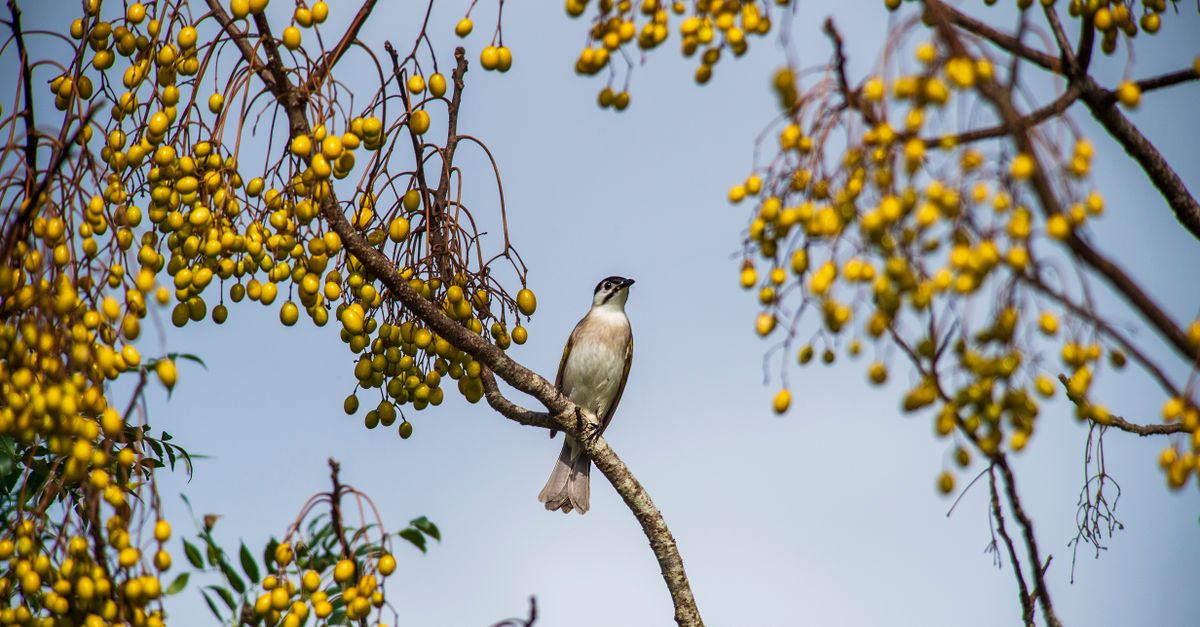
Melia dubia (Malabar neem, malai vembu) is a fast-growing native tree that works on most farm soils in peninsular India with at least 800 to 1,000 mm of rain or regular irrigation, and it is sold mainly to plywood, match, packing-case and paper mills. The real constraints are that it needs water in the first years, that sale prices are set by local mills, and that the published harvest-age and yield figures differ widely from source to source.
Two kinds of numbers circulate. Extension notes quote 12 to 15 cubic feet (0.4 to 0.5 m3) of timber per tree in 5 years, while a field study in Karnataka measured about 0.08 m3 per tree between 3 and 5 years. Budget on the lower, measured figures until a mill buyer or a neighbour's plot shows otherwise.
Where it grows in India
- Native range: Western Ghats and moist deciduous forests of Kerala, and also reported from the Khasi hills, Odisha hills, north Bengal, Sikkim, upper Assam and the Deccan Plateau.
- Planted areas: measured plantations are reported from Bidar (Karnataka), Tamil Nadu (IFGTB Coimbatore, Forest College Mettupalayam) and Jhansi (Uttar Pradesh, RLBCAU trials).
- Climate: tropical to subtropical, rainfall about 800 to 1,000 mm and above, altitude 600 to 1,800 m in the native habitat. Young seedlings tolerate mild cold but not severe frost, and the tree is damaged by fire and by browsing animals when young.
- Soil: fertile sandy loam, red and lateritic soils do best; shallow gravelly soil limits growth. TNAU notes that growth without irrigation is about 50% slower.
- Light: seedlings struggle in shade, so plant in open sun.
Planting material
- Seed: collect ripe drupes in January to February. Germination is reported below 25% by one source, while IFGTB Coimbatore reports up to 60% even without pretreatment. A nursery bed takes 6 to 7 kg of dried drupes (about 1,500 seeds), sowing is March to April, germination takes up to 90 days, and seedlings need about 6 months in the nursery.
- Cuttings and clones: young stem cuttings treated with 1,000 to 2,000 ppm IBA root at about 75%. Forest College Mettupalayam has a mini-clonal method using 90 cc root trainers with coir pith, where rooting starts within 15 days.
- Seedlings from random seed vary a lot in growth. Ask nurseries which clone or seed source they supply and where it has been tested. No named, officially released Melia dubia variety with verified Indian trial data was found.
Spacing and planting
| Spacing | Trees per acre | Trees per hectare | Note |
|---|---|---|---|
| 2 x 2 m | about 1,000 | 2,500 | Highest 5-year net return in an Indian Forester economic study |
| 3 x 3 m | about 444 | 1,111 | TNAU planting spacing; common farmer choice |
| 5 x 5 m | about 162 | 400 | Called optimal in TNAU and Indian Farming; leaves room for intercrops |
| 8 x 8 m | about 63 | 156 | Called ideal for individual tree growth; long wait for canopy closure |
- Pits are 45 x 45 x 45 cm. Plant 6-month-old seedlings at the start of rains, or with irrigation.
- Close spacing gives more total wood but thinner trees. Plywood mills pay more per tonne or cubic foot for girth above 120 cm (see prices), so decide the product first.
- Annual pruning, or twice a year in the early years, keeps the trunk straight.
Nutrition and irrigation
- Early growth is helped by daily watering in the first period and fertiliser every 3 months for the first 3 years (TNAU). In dry seasons, water every 10 to 15 days.
- Indian Farming (April 2025) suggests 25 to 50 g each of N, P and K per tree twice a year, adjusted to tree size. That is roughly 22 to 44 kg of each nutrient per acre a year at 444 trees per acre; treat it as a starting point and follow a soil test and local KVK advice.
- Weeding: TNAU recommends weeding twice a month until age 3 at 3 x 3 m spacing; intercrop tillage does most of this job.
- Drip suits the crop; see drip irrigation.
Intercrops
Groundnut, chilli, turmeric, ginger, black gram, green gram, lentil, melon, foxtail millet, sugarcane, banana and papaya are listed by TNAU and Indian Farming for the early years, until the canopy closes. No allelopathy has been reported.
Pests and diseases
- Few Indian extension sources give a full pest list for Melia dubia. IFGTB ran a 2012 to 2014 project to screen germplasm for key insect pests, and red spider mite control is described as removing infested leaves or spraying neem oil under the leaves.
- Young seedlings can get root rot in waterlogged cutting beds. Forest College Mettupalayam ran a 2017 to 2020 project on termites infesting live trees, so watch young plantings for termite damage.
- For any chemical, follow the label and ask your KVK or forest research station. See pests.
Harvest and yield
| Source | Claim |
|---|---|
| TNAU Agritech | Harvest in 6 to 7 years; 12 to 15 cu ft (0.4 to 0.5 m3) per tree at 5 years under intensive care; growth 20 to 25 cm a year if managed, 6 to 8 cm if not (the source does not say whether this is girth or height) |
| Indian Farming, April 2025 | Rotation of 8 to 12 years for agroforestry |
| Karnataka spacing study | Best individual tree at 3 to 5 years: 0.081 m3 volume and 84.6 kg biomass at 4 x 2 m; 3 x 3 m close behind |
| Bidar biomass study | Highest above-ground biomass 23.64 t/ha in 5 to 7 year plantations at 3 x 3 m (about 9.6 t per acre) |
The gap between 0.4 to 0.5 m3 per tree and 0.08 m3 per tree is large and unexplained in these sources. A tree harvested for plywood needs enough girth, so a 5-year harvest is realistic only on good, irrigated land with intensive care. The TNAU note does not state the area, soil or management behind its figures.
Cost and returns
- Prices quoted by TNAU and Indian Farming (undated, not current): ₹7,300 per tonne for billets of 50 to 120 cm girth, and ₹370 per cubic foot for trees above 120 cm girth. TNAU's own financial example uses ₹4,500 per tonne for pulpwood and ₹7,500 per tonne for plywood. Mill prices change by region and year, so ask two or three mills for today's rate and written grade rules.
- Arithmetic from measured biomass: about 9.6 t per acre x ₹4,500 to ₹7,500 per tonne = about ₹43,000 to ₹72,000 gross per acre over 5 to 7 years. It is unclear whether the study's biomass is green or dry weight and whether it counts branches, so this is only a rough guide.
- Published economics: an Indian Forester study on 5-year-old trees reported a net return of ₹752,791 for 2 x 2 m spacing and a benefit-cost ratio between 2.45 and 3.35 across four spacings. The abstract available did not show the area basis or prices used, so the figure should not be copied into a plan.
- Costs: seedlings, pits, irrigation, fertiliser and weeding, and fencing against browsing. No verified per-acre cost figure was found; get a nursery quote and add irrigation, which is the biggest running cost.
Market and risks
- Buyers are plywood and veneer mills, match and packing-case units, pulp and paper mills and traders. The wood is very light (specific gravity 0.33), lacks durability outdoors, and is not a furniture hardwood.
- Be careful with nurseries that promise "teak-like" returns, fixed buy-back or crores per acre. Those claims rest on the highest volume figure and a high price together.
- Felling and transit rules for farm-grown trees differ by state. This guide could not verify the rule for Melia dubia in each state, so check with your district forest office before planting a large block.
- Rainfed plots grow slowly, so a drought year in the first two years is the main loss risk.
- No verified MIDH or state subsidy rate for Melia dubia was found. Check the subsidy finder, and use an FPO for a joint sale to a mill.
Sources
- TNAU Agritech Portal, Industrial Forestry: Melia dubia
- TNAU Agritech Portal, Forestry Technologies: Melia dubia
- Indian Farming, April 2025, Malabar neem (Melia dubia): a promising agroforestry tree in India (RLBCAU Jhansi)
- Indian Forester, Economic Feasibility of Five Year Old Melia dubia in Different Planting Densities
- Indian Forester, Growth and Productivity of Melia dubia under Varying Spatial Configurations and Age Gradations
- Assessment of Biomass Productivity of Melia dubia in Bidar District, Karnataka (KrishiKosh)