
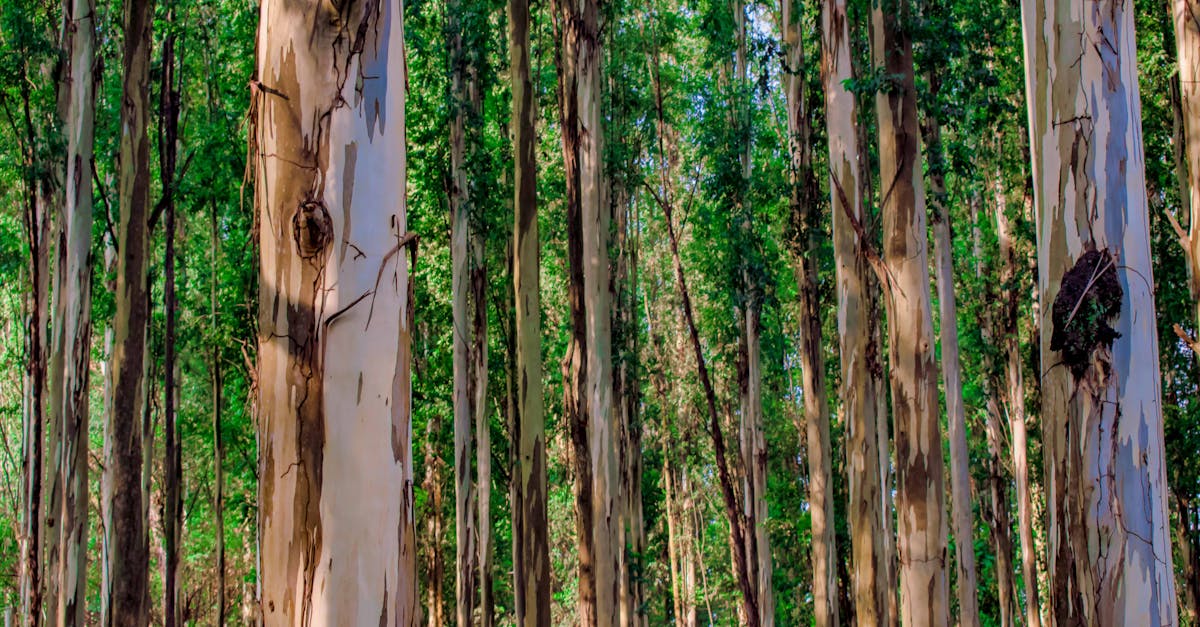
Clonal eucalyptus pays only where a paper mill or wood buyer is within a practical haul and where the land has enough water and no legal restriction. It is grown on a 4 to 8 year rotation for pulpwood, poles and firewood, and the tree uses a lot of water, so it is a poor choice on scarce-groundwater land and is restricted in parts of Karnataka.
Clonal stock has clearly out-yielded seedlings in Indian company and state-corporation plantations, but farm-level yield claims vary widely, and the price you get depends on the mill's buying terms on the day.
Where it grows and what it needs
- Regions: clonal pulpwood plantations are concentrated around paper mills in Andhra Pradesh and Telangana (ITC Bhadrachalam clones), Tamil Nadu (contract tree farming), and in Chhattisgarh, where Orient Paper and ITC signed agreements with the state forest department for supply of Nilgiri clones and buy-back. In Uttar Pradesh, Punjab and Haryana, eucalyptus is grown on field bunds, boundaries and in agroforestry blocks.
- Climate and soil (TNAU): rainfall of 330 to 1,500 mm and soil pH 6 to 8; avoid highly alkaline or saline land, eroded land and places where water stands.
- Water: a hydrological study at Hosakote, Karnataka measured eucalyptus water use of 3,400 mm over three years against 2,100 mm of rainfall. In Kolar district, about 17.7% of the district was converted to eucalyptus between 1972 and 2011, with about a 30% fall in groundwater recharge and runoff reported. Do not plant it next to a borewell or tank you depend on.
Clones and planting material
| Clone group | Source | Traits | Suited to |
|---|---|---|---|
| Bhadrachalam clones (E. tereticornis clones 3, 4, 6, 7, 10 and others) | ITC Bhadrachalam Paperboards, Andhra Pradesh | Evaluated at 4.5 years; company claims about 25 m3 per hectare a year rainfed and about 50 m3 under irrigation | Andhra Pradesh, Telangana and surrounding mill areas; supplied through the mill's own programmes |
| IFGTB clones (C-7 to C-196 series; 16 shortlisted from 24) | ICFRE-IFGTB, Coimbatore | 16 clones shortlisted out of 24 tested | Southern states; ask IFGTB or your state forest department for current release and availability |
| APFDC clonal plantations | A.P. Forest Development Corporation | Reported at least 50 t per hectare at 7 years with 96% survival | Andhra Pradesh |
- Buy rooted cuttings of a named clone from a mill, forest department or ICFRE nursery. Seedlings give uneven stands: seed-raised plantations in Andhra Pradesh averaged about 10 t per hectare at 8 to 9 years, against 40 t projected, and later rotations gave a third to a quarter of the first.
- Ask the mill which clone it will buy. A clone that is not accepted at the mill gate has no sale.
Spacing and planting
- TNAU lists 2 x 2 m for clonal plantations, which is about 1,000 plants per acre (2,500 per hectare). A 3 x 2 m spacing, often used for pulpwood, is 1,667 plants per hectare, about 675 per acre; 2.5 x 2.5 m is about 650 per acre.
- For agroforestry in Uttar Pradesh, Punjab and Haryana, an Indian Forester study tested 2.5 x 2.5 m, 3 x 1.5 m, 4 x 2 m and 6 x 1 m and concluded that wider spacing combined with crops at an 8-year rotation gave high returns. Rows on bunds and boundaries lose less crop.
- Plant at the start of the rains, keep the field weed-free in the first year, and fence against grazing. Trees reach about 3.2 m in two years (TNAU).
Management
- Plantations are grown mostly on rainfall; irrigation and fertiliser raise yield where water is available. TNAU's high yield is quoted only for sites with water.
- Weeding, pruning and thinning are the main operations. A basal dose of manure and a starter fertiliser at planting, as advised for your soil by the state forest department or KVK, is common; no verified per-tree dose was found.
- For pests and diseases in your district, ask the clone supplier and your forest department or KVK, and follow the label for any chemical.
- Coppicing: the stump can regrow for a second harvest, but in Andhra Pradesh seed-raised second rotations gave only a third to a quarter of the first. For clones, keep the coppice crop only if the mill accepts it and the stand is healthy; ask the clone supplier whether the clone is meant to be coppiced.
Harvest and yield
- Rotation: TNAU gives 4 years for clonal varieties; APFDC reports 7 years; trials in northern agroforestry used 8 years.
- Reported yields: at least 50 t per hectare at 7 years (APFDC, about 20 t per acre); about 70 t per hectare in 6 years reported for Bhadrachalam clonal pulpwood (about 28 t per acre); TNAU's average of 40 t per acre at 4 years where water is available, which is about 100 t per hectare and well above the other figures. Plan on the lower figures unless a nearby grower's records say otherwise.
- Keep a harvest and transport plan with the mill, since the wood is paid by weight at the gate and loses moisture if stacked.
💡 Tip: Before buying plants, get the mill's current price per tonne, the accepted clones and the lifting and payment terms in writing, and confirm your state's rules on felling and transit.
Cost and returns
- Revenue figure: TNAU says about ₹75,000 per acre in revenue every 4 to 5 years.
- Sensitivity: at 20 to 28 t per acre (the 6 to 7 year clonal reports), every ₹1,000 per tonne of price is ₹20,000 to ₹28,000 per acre. Use the price your buyer quotes now, not an old figure.
- Costs are plants, land preparation, fencing, weeding, protection, harvesting and transport. No verified cost per acre was found; get quotes from the mill or the forest department.
- Income comes once in 4 to 8 years with no cash flow in between, unless you intercrop; the money is tied up, and a change in the mill's price or buying terms falls on you.
Market and risks
- Buyers are paper and pulp mills, plywood and pole buyers and biomass users. Mills run buy-back and supply programmes in several states; read the written terms before signing.
- Price is the main risk: in Andhra Pradesh the government announced new purchase prices to rescue social forestry planters after growers struggled to sell. Wood sold to a trader without a mill link can get a weak price.
- Legal limits: Karnataka banned new eucalyptus and acacia plantations in February 2017, and eucalyptus cultivation is restricted in the Malnad and semi-Malnad districts (Shimoga, Chikmagalur, Hassan, Uttara Kannada, Kodagu). The Karnataka Preservation of Trees Act, 1976 requires permission to fell in notified areas. Other states have their own felling and transport rules; check with your state forest department before planting.
- See FPO for group selling and subsidy finder for plantation support; no state subsidy rate was verified here. For other farm trees see poplar.
Sources
- TNAU Agritech Portal, eucalyptus
- Indian Forester, high-yield eucalyptus clonal plantations of A.P. Forest Development Corporation
- Indian Forester, growth, biomass and yield variation in Eucalyptus tereticornis clones from ITC Bhadrachalam
- Indian Forester, economics of eucalyptus plantations under agro-forestry
- Hydrology and Earth System Sciences, eucalyptus water use greater than rainfall input, southern India
- ICRISAT, land use change and groundwater in Kolar district
- India Environment Portal, Karnataka restricts eucalyptus cultivation
- Papermart, Orient Paper and ITC agreement with Chhattisgarh Forest Department