
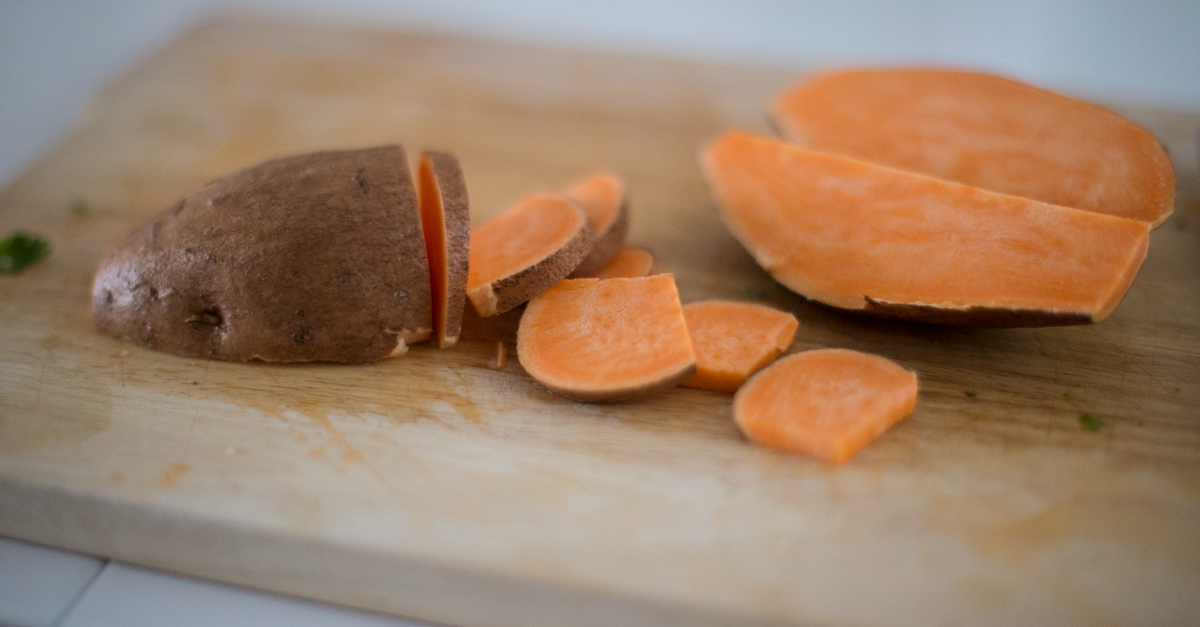
Orange-flesh sweet potato (OFSP) is an easy crop to grow, 110 to 120 days from vine cutting on ordinary soil, but a hard one to sell at a premium: there is no Indian price series for it, and most buyers still pay the plain sweet potato rate. It works best for farmers near a nutrition programme, a processor, an SHG or an urban retail channel that already wants the orange colour.
The orange comes from beta-carotene, a precursor of vitamin A. Indian trials measured about 4 to 12 mg per 100 g of fresh tuber in orange lines, so the nutrition claim is real, but the premium is not guaranteed. ICAR-CTCRI (Thiruvananthapuram) breeds most Indian OFSP lines. Sweet potato in India covers roughly 1.3 lakh ha at an average of 10.9 t/ha (ICAR-CTCRI 2023, as cited in a 2026 trial paper).
Where it grows in India
- Main states: Odisha, Bihar, West Bengal and Uttar Pradesh hold most of the area; Kerala, Tripura and other north-eastern states grow it too. OFSP work by CTCRI and KVKs has been reported from Attappadi (Kerala), Odisha, West Bengal, Karnataka and Tripura.
- Climate: warm, moist weather with no frost; it tolerates dry spells once vines cover the ground.
- Soil: loamy, well-drained soil with pH 5.6 to 6.6 (TNAU). Heavy waterlogged clay gives poor tubers.
- Season (TNAU): June to July and September are the most suitable planting months in Tamil Nadu. KAU notes irrigated planting in December to January after the second rice crop, which suits rice-fallows.
Varieties
| Variety | Source | Traits | Notes |
|---|---|---|---|
| Bhu Sona | ICAR-CTCRI | Orange to yellow flesh; 26.3 t/ha, dry matter 30.4%, TSS 14.6 °Brix and the best taste score in a 2024-25 KVK Dhalai (Tripura) trial; beta-carotene quoted at 8 to 12 mg per 100 g in the trial discussion | Single-site trial; best-documented CTCRI nutrition variety |
| SP 95/4 | ICAR-CTCRI | 8 mg beta-carotene per 100 g; tubers about 300 g, spindle-shaped, suited to processing | Used in the Attappadi (Kerala) tribal programme |
| ST 14 | ICAR-CTCRI, Bhubaneswar (Odisha) | Orange flesh, brown skin; beta-carotene 11.3 mg per 100 g fresh; low sweetness | 2012 lab study; check present availability |
| S 61 | ICAR-CTCRI, Thiruvananthapuram | Orange flesh, pink skin; beta-carotene 11.0 mg per 100 g fresh; low sweetness | 2012 lab study; check present availability |
| Kamala Sundari | BCKV, Kalyani (West Bengal) | Orange flesh, brown skin; beta-carotene 6.9 mg per 100 g fresh; low sweetness | 2012 lab study; check present availability |
| SV 98 | ICAR-CTCRI, Thiruvananthapuram | Orange flesh; dry matter 27.7%; beta-carotene 6.8 mg per 100 g fresh; moderate sweetness | 2012 lab study; check present availability |
- Beta-carotene varies by variety and by lab, so ask the supplier for a test report before you promote any variety as high in vitamin A.
- Deeper orange flesh usually, but not always, means more beta-carotene, and orange types are often less sweet than local yellow or white ones. Taste-test with your buyers.
- Planting material (vine cuttings) is the practical constraint. Get vines from ICAR-CTCRI, its regional centre at Bhubaneswar, your KVK or a state agriculture university, with the variety name in writing.
Planting material and spacing
- Nursery: TNAU advises raising vines in a nursery from weevil-free tubers and taking 10 to 15 cm cuttings with 2 to 3 nodes from vines older than 3 months; KAU uses 20 to 25 cm cuttings. Dip or treat the cuttings with Azospirillum as per TNAU.
- Ridges: 60 cm apart (TNAU, KAU). Plant cuttings 15 to 20 cm apart on the ridge, which is about 80,000 cuttings per hectare, or 32,000 per acre.
- The Tripura KVK trial used 75 cm x 30 cm, about 44,000 plants per hectare (17,800 per acre).
- Use only clean, weevil-free vines; infested planting material is the main way the sweet potato weevil enters a field.
Nutrition and irrigation
- TNAU: 25 t per hectare of farmyard manure (10 t per acre) and 20:40:60 kg N, P2O5, K2O per hectare at planting, with the same dose again 30 days later. The total is 40:80:120 kg per hectare (16:32:49 kg per acre). TNAU cuts nitrogen to two-thirds if Azospirillum is applied.
- Tripura KVK trial: 10 t per hectare of farmyard manure and 50:25:50 kg N, P2O5, K2O per hectare, with half the nitrogen and all P and K at planting and the rest of N 30 days later.
- Very high nitrogen gives vines but small tubers. Use your soil test and see fertilizers.
- Irrigation (TNAU): before planting, on day 3, then weekly until one week before harvest. Earth up at 25, 50 and 75 days and lift the vines at 50 and 75 days so they do not root at the nodes.
Pests and diseases
- Sweet potato weevil (Cylas formicarius): the main loss. A 2026 trial paper reports damage of up to 70% in severe cases elsewhere; in the Tripura trial weevil incidence was about 4 to 5% in the improved varieties and 6.5 to 7.9% in local ones under neem and pheromone-trap management.
- Control by clean planting material, crop rotation, removing residues after harvest, earthing up around 50 days so tubers are not exposed in cracks, pheromone traps and neem-based sprays. For any insecticide, follow the label and ask your KVK.
- Soft rot: TNAU suggests carbendazim at 1 g per litre as a spot drench. Keep fields drained.
Harvest and yield
- Harvest: TNAU gives 20 to 25 t per hectare of tubers in 110 to 120 days, which is 8 to 10 t per acre. Stop irrigation a week before digging.
- Trial yield: Bhu Sona gave 26.3 t per hectare (10.6 t per acre) in the 2024-25 Tripura trial, against 16 to 20 t per hectare for local sweet potatoes in the same trial.
- Farm average: India's average is 10.9 t per hectare (4.4 t per acre), so plan on your own record, not on the trial peak.
- Fresh tubers keep poorly, and weevil damage grows in store. Plan sales within days to a few weeks of digging.
Cost and returns
- Price (plain sweet potato, Odisha): on 1 September 2026 mandi prices were ₹4,000 to ₹4,200 per quintal at Bhanjanagar (Ganjam), with the other Odisha mandis topping out at ₹2,500 to ₹3,000. Prices are higher in the lean season and fall at harvest. No Indian price series for orange-flesh tubers specifically was found, so ask buyers for a written rate. See mandi bhav.
- Arithmetic (illustration): at the average of 4.4 t per acre and ₹2,500 per quintal, gross income is about ₹1.1 lakh per acre (44 quintals x ₹2,500). At 8 t per acre and ₹2,500 per quintal it is about ₹2 lakh. At 10 t per acre and ₹4,000 per quintal it is ₹4 lakh, which needs good yield, lean-season sales and a ready buyer.
- Costs: no verified cost of cultivation for OFSP was found. Main items are vines, farmyard manure, ridging, weeding, earthing up, irrigation and digging labour. Get a local estimate from your KVK before deciding.
Market and risks
- Buyers: nutrition programmes and NGOs, SHG-run processing for chips, flour and puree, health-food retailers and local markets. Quality vines, cold storage and processing capacity are thin in many districts, so ask your KVK what exists near you.
- Risks: weevil, perishability, price crash at harvest, and low sweetness of some orange lines for local taste. Selling a "superfood" label needs a lab report on beta-carotene.
- Selling together through an FPO helps with transport and processing contracts. Check the subsidy finder; no scheme rate specific to OFSP was verified. For kharif planning see crop calendar.
Sources
- Debnath et al., Performance evaluation of biofortified sweet potato varieties under Eastern Himalayan condition, Plant Archives 26(S1), 2026 (KVK Dhalai, Tripura)
- Roy et al., Tuber quality assessment of orange-fleshed sweet potato cultivars, Indian Journal of Agricultural Sciences 82(6), 2012
- TNAU Agritech Portal, Sweet potato (Ipomoea batatas)
- Kerala Agricultural University, Agri-Infotech Portal, sweet potato land preparation and planting
- GKToday, ICAR-CTCRI orange-fleshed sweet potato SP-95/4 and the Punarjeevanam project, 1 April 2025 (secondary source)
- NaPanta, sweet potato mandi prices in Odisha, 1 September 2026 (Agmarknet data)