
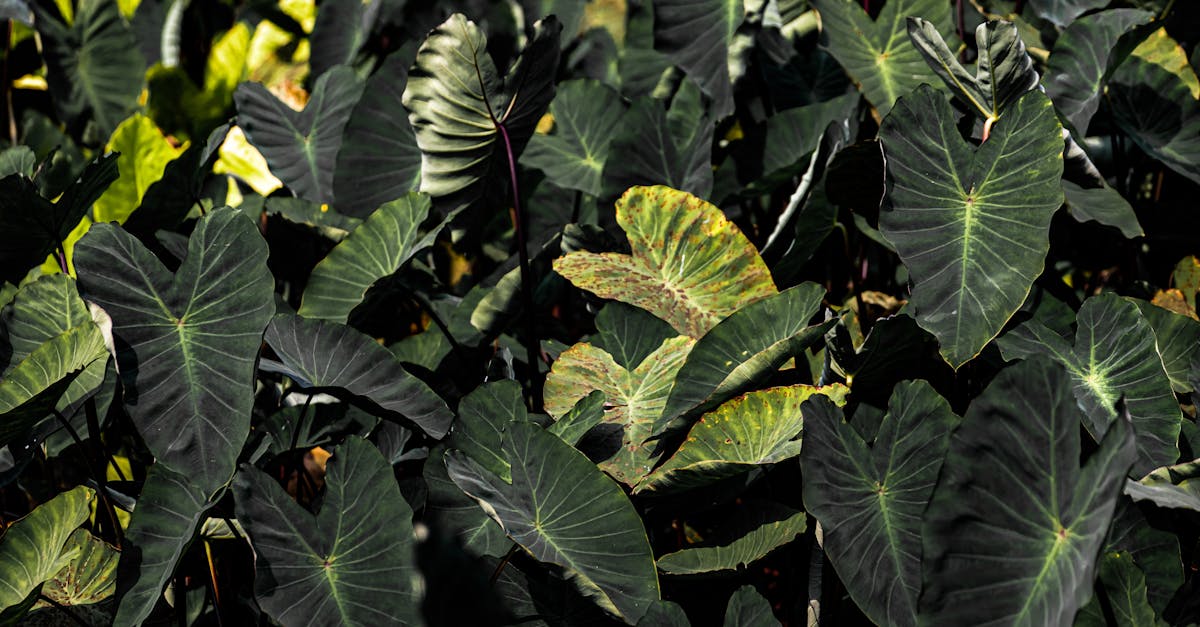
Colocasia (arbi, taro, ghuiyan) is a dependable vegetable corm crop that works across most of India below about 1,500 m, in warm, humid conditions with 1,000 mm of rain or regular irrigation. It needs a loamy soil, planted cormels, about 6 to 8 months, and a leaf blight plan for the rains.
Published yields vary widely: about 8 to 10 t/ha in a standard package of practices, 15 to 20 t/ha for the improved Kerala varieties, and up to 20 t/ha of main corms plus 15 t/ha of side cormels in a Meghalaya trial. Pick the variety your local market likes and plant in the season your area is known for.
Where and how it grows
- Climate: mean temperature of 21 to 27°C, up to 1,500 m elevation, and about 1,000 mm of rain during the growing period; give supplementary irrigation where rain is short (TNAU).
- Soil: loamy soil, pH 5.5 to 7.0 (TNAU). Colocasia is a wetland-origin plant that tolerates wet soil better than most tubers, but the standard package still irrigates once a week rather than flooding.
- Season: June to July and February to March are the suitable planting windows in the TNAU package. The ICAR Umiam trial in Meghalaya planted in March and harvested at 240 days under rainfed conditions.
- Acridity: raw corms, cormels and leaves contain calcium oxalate crystals that cause itching. Cooking or overnight soaking removes it, and good-quality corms are fibreless and soft when cooked. If a variety itches after cooking, buyers will not pay well for it.
Varieties
| Variety | Source | Traits |
|---|---|---|
| Sree Rashmi | ICAR-CTCRI, Thiruvananthapuram | 7 to 8 months; 15 to 20 t/ha; tall (100 to 150 cm); conical cormels; good cooking quality |
| Sree Pallavi | ICAR-CTCRI | 6.5 to 7 months; 15 to 18 t/ha; 20 to 25 small cormels per plant; field tolerant to leaf blight and mosaic (KAU portal) |
| Sree Kiran | ICAR-CTCRI | 6.5 to 7 months; first hybrid taro in India; cormels keep well |
| Panchamukhi, Co 1, Satamukhi (Kovvur) | Listed as popular cultivars in the TNAU package | In the Umiam trial Panchamukhi gave the highest corm yield (20 t/ha, 1.5 kg average corm) and White Gouriya the highest cormel and total yield (15.29 and 25.92 t/ha) |
- In the Umiam trial Nayabungalow had the least leaf blight (8% incidence). Oxalic acid and starch differed among cultivars, so local trial results matter more than names.
- Get planting cormels from a state agricultural university, KVK or ICAR-CTCRI rather than from the general market, which may carry blight and mosaic.
Planting material and spacing
- Planting material: cormels of 20 to 25 g, planted 2.5 to 7.5 cm deep (TNAU). The Umiam trial used sprouted corms or cormels 5 to 7 cm deep.
- Seed rate: 800 kg/ha, about 325 kg per acre (TNAU).
- Spacing: ridges and furrows 45 cm apart with plants 45 cm apart in the furrow (TNAU), which is roughly 20,000 plants per acre or 49,000 per hectare. The Umiam trial also used 45 x 45 cm. Another ICAR-reported spacing is 60 x 40 cm.
Nutrition and irrigation
| Stage | Per hectare | Per acre (approx.) |
|---|---|---|
| Basal: FYM | 25 t | 10 t |
| Basal: N, P, K | 20, 30, 60 kg | 8, 12, 24 kg |
| Top dressing at 45 days: N, P, K | 20, 30, 60 kg | 8, 12, 24 kg |
- Total is 40 kg N, 60 kg P and 120 kg K per hectare (TNAU), about 16, 24 and 48 kg per acre. Turn this into fertiliser bags with a soil test and the fertilizer guide.
- Irrigate once a week (TNAU), more often in sandy soil or hot spells. Drip is an option where water is short.
Pests and diseases
- Leaf blight (Phytophthora colocasiae): the main risk in the rains, with losses up to 50% reported by TNAU. Use tolerant varieties such as Sree Pallavi, clean planting material, and good drainage between rows.
- Aphids and leaf-eating worms: TNAU lists quinalphos or dimethoate at 0.05%. Follow the label, observe the waiting period and check the current recommendation with your local KVK, since the leaves and corms are eaten.
💡 Tip: Stagger plantings by 3 to 4 weeks on small plots. It spreads the harvest and reduces the chance of the whole crop meeting blight weather at once.
Harvest and yield
- Maturity takes 6 to 8 months (TNAU), and TNAU quotes about 8 to 10 t/ha in 180 days.
- CTCRI reports 15 to 20 t/ha for Sree Rashmi and 15 to 18 t/ha for Sree Pallavi. In acre terms that is about 3.2 to 4 t/acre in the standard package and 6 to 8 t/acre for the improved varieties.
- Main corm and side cormels are separated at harvest; cormels are the usual market product. Sort by size before sending to market.
Cost and returns
- No verified Indian cost-of-cultivation figure for colocasia was found, so none is given here. Seed cormels (325 kg per acre), labour for ridging, weeding and harvest, and FYM are the main costs.
- Arithmetic to use: gross income = yield x price. At 3.2 to 8 t per acre, every ₹10 per kg of farm-gate price is ₹32,000 to ₹80,000 per acre. Check the current rate for arbi at your nearest mandi in mandi bhav before planning, as prices swing with season and arrivals.
- Subtract seed, FYM, fertiliser, labour and transport. Because the crop takes 6 to 8 months, compare the result with what a shorter vegetable would earn on the same land.
Market and selling
- Arbi is a regular vegetable in town markets across India, and in the North-East all plant parts, including leaves and petioles, are eaten. Sell to local vegetable wholesalers, with sorted and washed cormels earning better.
- No Indian data was found on fixed-price buyers for leaves, so confirm a buyer first, and treat leaf income as a bonus rather than a plan.
- Group selling through an FPO helps with transport. Crop insurance cover can be checked at PMFBY, and the subsidy finder lists current schemes.