
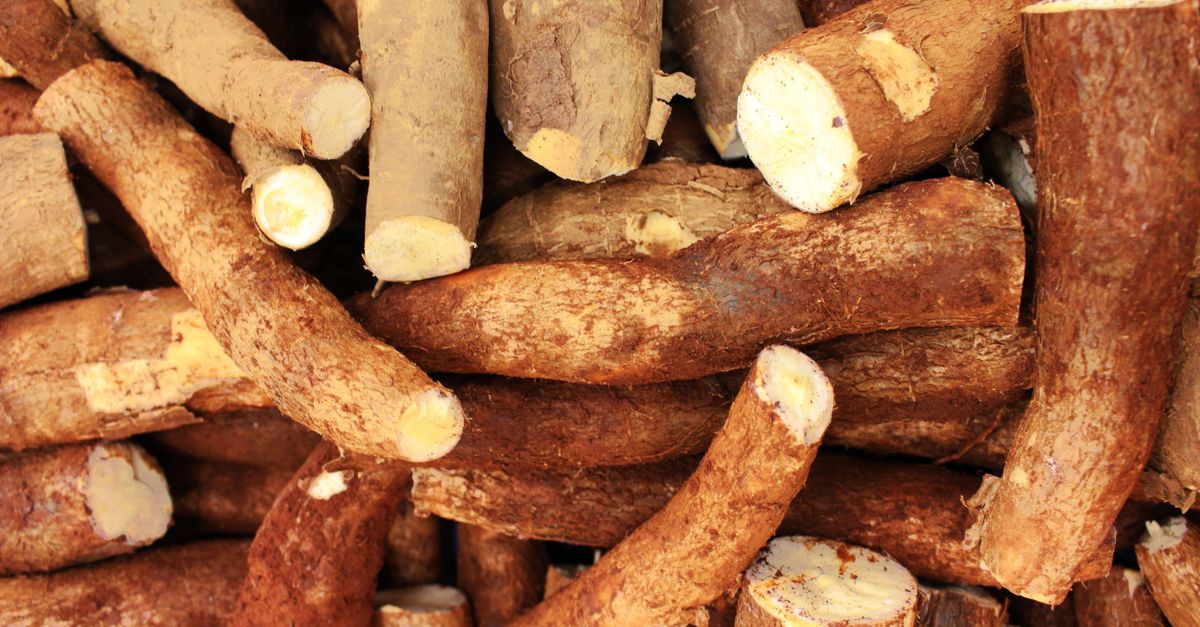
Industrial tapioca (cassava) is a proven crop in India, but only in the belt around Salem, Namakkal and Dharmapuri in Tamil Nadu where about 1,500 sago and starch units buy tubers by starch content. Outside that belt, with no factory within a short haul, it is hard to sell, because fresh tubers are bulky and meant for quick processing. What it takes is a nearby factory, an early agreement on price, and a variety with high starch.
Price is the main risk. TNAU's market intelligence cell has recorded Salem raw tapioca at anything from about ₹3,000 per tonne in poor years to ₹12,000 per tonne when supply fell, and farmers in the area have repeatedly shifted to maize when prices were low. No 2026 price was verified for this guide; ask the factories or TNAU DEMIC for the current rate before planting.
Where it grows in India
- States: Tamil Nadu and Kerala together hold about 89% of India's tapioca area. Kerala grows it mainly as a food crop, Tamil Nadu mainly for industry. It is also grown in Andhra Pradesh and the north-east.
- Tamil Nadu districts (2010-11, TNAU): Dharmapuri about 29,900 ha, Namakkal 21,540 ha, Salem 19,550 ha, Villupuram 11,520 ha, Erode 8,690 ha. Tamil Nadu's total was about 1.2 lakh ha. Area has been moving into Trichy, Cuddalore, Karur and Tiruvannamalai.
- Climate: a warm, mostly rainfed crop in Tamil Nadu. Cassava tolerates drought, but tuber rot is a known loss, so drainage matters.
- Productivity: TNAU reported India's average cassava yield at about 34.75 t per hectare in 2011-12, while an earlier TNAU station paper put the national average at 22 t per hectare and said recommended practices can lift farm yields to 35 t.
Varieties
| Variety | Source | Traits | Notes |
|---|---|---|---|
| H-226 (White Rose) | ICAR-CTCRI hybrid | Starch about 27%; did well under rainfed conditions in Salem | Grown by all 60 farmers in a Salem survey |
| H-165 | ICAR-CTCRI hybrid | Starch 23 to 25%, 33 to 38 t per hectare, 8 to 9 months | Popular industrial type |
| Mulluvadi (MVD-1) | Popular in Tamil Nadu (TNAU) | Widely adopted for sago and starch | With H-226 and H-165 covers over 75% of area in Salem, Dharmapuri and Namakkal |
| Sree Athulya | ICAR-CTCRI, released 2014 | Triploid; 35 to 40 t per hectare, 10 months, extractable starch about 30% | Suited to irrigated plains of Salem, Namakkal, Dharmapuri |
| CO 2, CO 3, CO (TP) 4, CO (TP) CTCRI 5 | TNAU | TNAU station trials: 25.3 to 28.5% starch, 29.5 to 42.5 t per hectare with its practices | Newer ones had low adoption because setts were hard to find |
Ask the factory which variety it prefers; payment depends on starch, and planting setts from a disease-free source matters as much as the variety name.
Planting and spacing
- Season: TNAU describes rainfed planting around November to December and March to April, and irrigated planting around June to July, so harvest falls in the pre- or post-monsoon window. Check the exact window for your block with TNAU's Tapioca and Castor Research Station, Yethapur.
- Setts: 2 or 3 budded setts from healthy plants (all 60 surveyed Salem farmers used these). General guides give 20 to 30 cm length. Treating setts and raising a small nursery help weed out virus-affected plants.
- Spacing: a general guide gives 1 m x 1 m or 1 m x 0.8 m, about 4,000 to 5,000 plants per acre (10,000 to 12,500 per hectare). Use your variety's package, since branching types need more room.
- Nutrition: The TNAU station study lists farmyard manure and basal NPK, then top-dressing of nitrogen and potash about 90 days after planting when tubers start forming; micronutrients are advised too. Exact kg per acre depends on soil test and variety; follow the KVK or Yethapur schedule. See fertilizers.
- Station results: TNAU's Yethapur station reported 42.5 t per hectare using green manure (daincha) with potash and half-dose N and P plus biofertilizers, and 35.4 t per hectare from fertigation at 75% of the recommended dose. Black polythene mulch gave full weed control. See drip irrigation.
- Intercrops such as black gram, green gram and beans are used by Salem farmers.
Pests and diseases
- Key problems in the Salem study: cassava mosaic virus (spread by whitefly and in infected setts), tuber rot, red spider mite and Phomopsis leaf spot. Mosaic and tuber rot caused serious losses.
- Use disease-free setts, rotate crops, keep fields well drained and harvest on time. Neem-based sprays are an option for whitefly. Some older chemicals in package sheets are no longer permitted, so ask your KVK for the current recommendation. See pests.
Harvest and yield
- Duration: 8 to 10 months for the industrial hybrids above; 8 to 18 months in general depending on variety and use.
- Yield: 33 to 40 t per hectare (13 to 16 t per acre) for H-165 and Sree Athulya under good management. TNAU says such yields are reachable on farms with recommended practices, but ordinary field yields are lower.
- Timing: tubers reach factories from July to April, with the peak from November to February when starch is highest. Hill-grown tapioca harvested June to August fetches a premium for its colour in sago and starch.
- Fix the factory's intake date before digging, since tubers are for processing, not storage.
Cost and returns
- Cost: no verified per-acre cost of cultivation was found for this guide. Ask TCRS Yethapur or your KVK for the current cost sheet; setts, land preparation, manure, labour for planting, weeding, earthing up and harvest are the main items.
- Price history (Salem, TNAU and press): ₹9 to 10 per kg forecast for October-November 2013; ₹7,200 to 7,800 per tonne in mid-2015 with a forecast of ₹4,800 to 5,200; up to ₹12,000 per tonne in September 2019 after production had roughly halved in a decade, against as low as ₹3,000 earlier.
- Arithmetic (illustration, old prices): 14 t per acre (about 35 t per hectare) at ₹4,800 per tonne is about ₹67,000 gross; at ₹12,000 per tonne it is about ₹1.68 lakh. Subtract your own costs; at low prices the margin can vanish.
Market and risks
- Buyers: raw tapioca is priced by starch content. Salem has about 650 factories according to a TNAU study (about 1,500 sago and starch units in and around Salem by TNAU's 2013 count). The sago trade was reported at ₹504 crore in 2018-19, and sago supply through ration shops was announced as a further demand boost.
- Imports: in 2015 traders imported food and industrial starch from Vietnam and Thailand, which pulled sago and starch prices and then tuber prices down.
- Cycle: area shrinks after low prices, and prices rise when supply falls. Planting everything in a bad-price year is the usual mistake; a written arrangement with a factory protects you better than guessing the cycle.
- Group selling through an FPO helps negotiation. A Kisan Credit Card can fund the crop; check mandi bhav and PMFBY for insurance cover in your district.
Sources
- TNAU DEMIC, press note: tapioca will fetch good price, October 2013
- TNAU DEMIC, press note: hill grown tapioca price, 2015
- Journal of Agricultural Extension Management, awareness and adoption of recommended technologies by cassava growers (Salem)
- TNAU Tapioca and Castor Research Station, Yethapur: crop management
- ICAR-CTCRI, Sree Athulya
- DT Next, sago through PDS: farmers upbeat (September 2019)
- BigHaat, cassava farming guide (secondary source)