
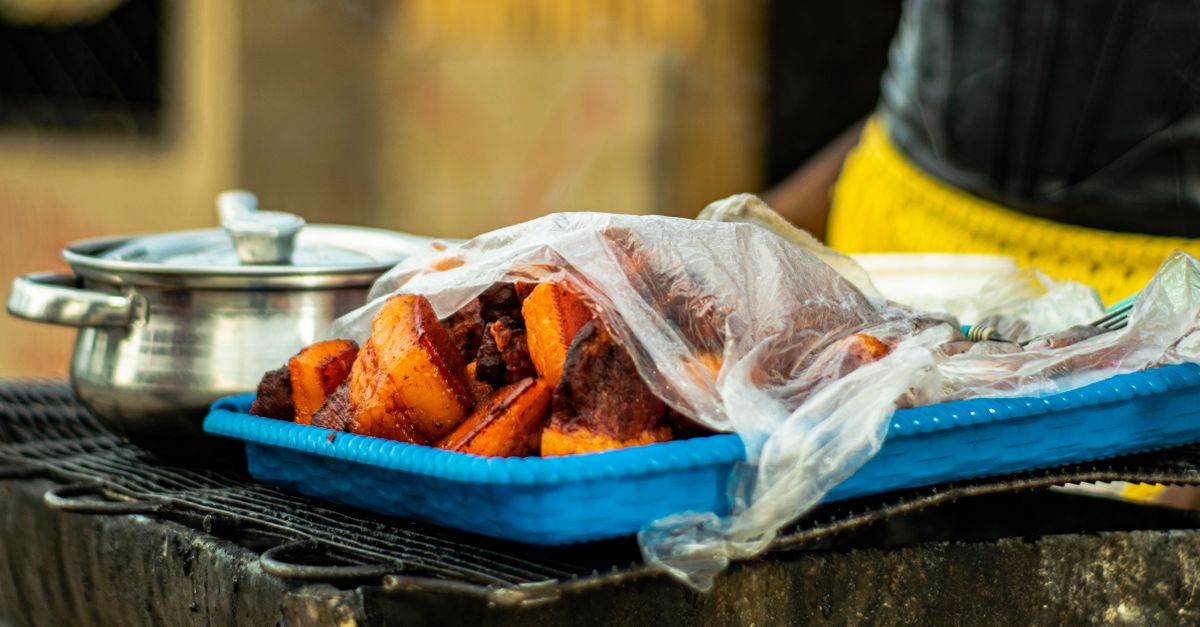
Greater yam (Dioscorea alata) is a long-duration, rainfed tuber crop that works where there is a warm, reasonably wet season and labour to stake the vines: Kerala, coastal Andhra Pradesh, Odisha, Tamil Nadu and the North East are its main regions. It takes 8 to 10 months, needs a pole or support for every plant, and the trial yields below swing from under 10 to over 40 tonnes per hectare depending on site and staking.
This page covers the field crop and its commercial angle. A reliable current mandi price for greater yam and an Indian processor buying it by contract could not be verified, so the returns section gives yield and cost arithmetic and tells you to fix the price locally before planting.
Where it grows in India
- ICAR-CTCRI and AICRP scientists list the greater yam states as Andhra Pradesh, Kerala, West Bengal, Bihar, Odisha, the North Eastern states, Uttar Pradesh, Tamil Nadu, Gujarat, Maharashtra and the Andaman and Nicobar Islands. It is mostly a homestead or semi-commercial rainfed vegetable crop.
- The area under all yams is about 27,000 ha with productivity of 15 to 30 t/ha (AICRP Tuber Crops, 2016).
- Climate: warm and humid; the Kerala trial site had 30 to 35 °C maximum, 23 to 26 °C minimum and 1,330 to 1,546 mm rain over the crop period.
- Soil: deep, well-drained sandy clay loam or sandy loam. Yield was poor on the heavy black soil at Navsari (6.8 t/ha unstaked, 16.4 t/ha staked), where drainage and soil type limit the crop.
Varieties
| Variety | Released by | Traits | Suited to |
|---|---|---|---|
| Sree Keerthi | ICAR-CTCRI | 9 to 10 months; average 25 to 30 t/ha; large tubers; vine climbs 4 to 5 m; suits banana and mature coconut gardens | Kerala-type humid tropics; intercropping |
| Sree Karthika | ICAR-CTCRI | 9 months; average 30 t/ha; long oval tubers; starch 21.4% | Humid tropics and AICRP sites |
| Sree Shilpa | ICAR-CTCRI | 8 months; first Dioscorea alata hybrid; dry matter 33 to 35%, starch 17 to 19% | Shorter-duration situations |
| Sree Swathy | ICAR-CTCRI (as listed by KAU) | 30 t/ha; drought tolerance; starch 20% | Drier spells |
| Sree Nidhi, Sree Hima | ICAR-CTCRI (as listed by KAU) | 35 t/ha (Sree Nidhi) and 38 t/ha (Sree Hima) reported; starch 23.2% and 20.9% | Ask CTCRI for seed availability |
| Sree Neelima | ICAR-CTCRI (as listed by KAU) | 35 t/ha reported; light purple flesh; susceptible to anthracnose | Niche, coloured-tuber market |
Planting
- Season: tuber pieces are planted in February to April (late dry season); they sprout with pre-monsoon showers and the vines establish with the south-west monsoon in May to June. The ICAR-CTCRI Kerala trials planted between the last week of March and the second week of April.
- Planting material: tuber pieces of about 250 g from tubers harvested in January. Sprouting begins 16 to 28 days after planting and 50% sprouting took roughly 24 to 56 days in the Kerala trial.
- Spacing: 90 x 90 cm, which is about 12,300 plants per hectare (about 5,000 per acre). Seed need is about 3 tonnes per hectare (about 1.25 tonnes per acre) at 250 g per piece.
- Support: trail the vines on casuarina or bamboo poles after about 2 months; the crop needs 3 to 4 months to build a full canopy.
Staking pays
In the five-site AICRP trial, staked greater yam averaged 27.4 t/ha against 17.3 t/ha unstaked, a drop of about 54% without support. Staking raised yield by 15 to 100% depending on the site. Some districts of Odisha and Andhra Pradesh grow it unstaked on a commercial scale because poles and labour are costly, but that choice costs yield.
| Site (AICRP trial) | Soil | Staked yield (t/ha) | Unstaked yield (t/ha) |
|---|---|---|---|
| Kovvur, Andhra Pradesh | Sandy loam, pH 7.5 to 8 | 43.9 | 21.6 |
| Coimbatore, Tamil Nadu | Red loam, pH 8 to 8.5 | 43.8 | 30.6 |
| Jagdalpur, Chhattisgarh | Silty clay, pH 6 to 6.5 | 19.5 | 15.8 |
| Navsari, Gujarat | Heavy black, pH 7.5 to 8 | 16.4 | 6.8 |
| Dapoli, Maharashtra | Laterite, pH 5.5 to 6 | 13.5 | 11.7 |
Nutrition and irrigation
- ICAR-CTCRI recommendation: 10 t FYM plus 80:60:80 kg N, P2O5 and K2O per hectare (about 4 t FYM and 32:24:32 kg per acre), the fertiliser split in two parts at 50% sprouting and one month later. Check your soil test and see fertilizers.
- The crop is mostly rainfed. Active tuber bulking was in months 6 to 8 (180 to 240 days after planting) in the Kerala trial, so a dry spell then is the risk; ask your KVK about irrigation for your soil. See drip irrigation.
- Pests and disease: anthracnose is reported on susceptible varieties such as Sree Neelima. For current pest advice use only registered chemicals, follow the label and ask your KVK. See pests.
Intercropping
- Maize planted between yam rows (1:2, at 60 x 30 cm) and used to carry the vines gave the best yam-equivalent yield, 26.05 t/ha, land-equivalent ratio 1.46, benefit-cost ratio 4.12, land saving of 31.5% and up to 49% more net income than sole yam across five sites.
- Yam yield fell by about 23% with maize, 33% with sorghum and 37% with pigeon pea, and the yam must not be crowded by a crop that matures at the same time.
Harvest and yield
- Harvest at 8 to 10 months, when vines dry and senesce (senescence began at about 236 to 243 days in the Kerala trial).
- Kerala trial, timely planting: 26.4 to 31.5 t/ha for Sree Keerthi and 22.7 to 29.3 t/ha for Sree Karthika.
- AICRP five-site mean: 27.4 t/ha staked and 17.3 t/ha unstaked, but only 13.5 to 19.5 t/ha staked at Dapoli and Jagdalpur. Plan on the lower end outside humid, well-drained sites.
Cost and returns
- Revenue arithmetic: 20 t/ha is about 8 t per acre, so each ₹1 per kg of farm-gate price is about ₹8,000 per acre; at 27 t/ha (about 11 t per acre) each ₹1 per kg is about ₹11,000. Use the price quoted by your buyer or the nearest market in harvest month.
- Costs to count: seed pieces (about 1.25 t per acre), FYM, fertiliser, poles and tying (the heaviest item), labour for staking, weeding and digging, and transport. A verified Indian cost-per-acre figure was not available; ask your KVK or ICAR-CTCRI.
Market and processing
- ICAR-CTCRI describes yam tubers as eaten boiled, baked or fried, and used for chips, flakes and flour. A buyer for large-volume processing should be confirmed in writing before planting; none was verified here.
- A small crop is easiest sold fresh in local markets; agree the buyer, grade and price before planting a larger area.
- For group selling see FPO; compare local prices with mandi bhav; elephant foot yam is the other main yam-type crop, see elephant foot yam. Check subsidy finder for tuber-crop support; no current rate was verified here.
Sources
- Phenology of Greater Yam (Dioscorea alata L.) Under Humid Tropical Conditions of Kerala, ICAR-CTCRI (Journal of Root Crops, 2020)
- Influences of intercropping on productivity and profitability of greater yam, ICAR-CTCRI and AICRP Tuber Crops (Journal of Crop and Weed 18(2), 2022)
- Kerala Agricultural University CELKAU, Greater yam varieties