
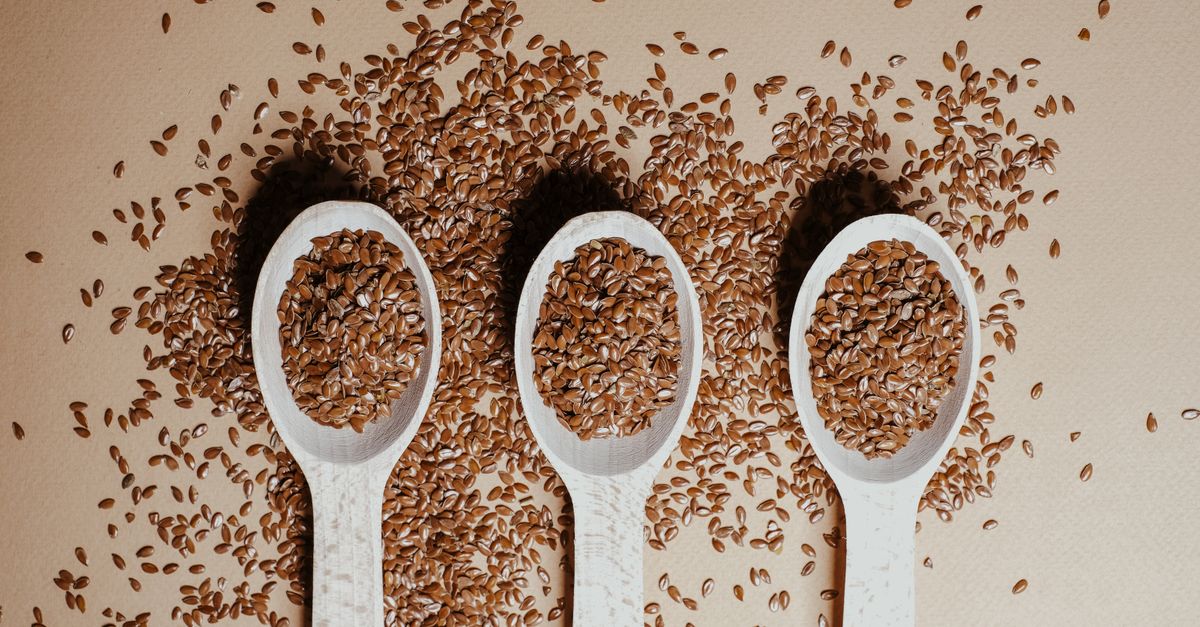
Flax (alsi, tisi; Linum usitatissimum) is an established rabi oilseed in Madhya Pradesh, Chhattisgarh, Uttar Pradesh, Maharashtra, Bihar and Odisha, and it suits rainfed or lightly irrigated land sown in October to November. It is a low-input crop, but Indian yields are small (demonstration plots reached about 6 quintals per acre with irrigation and about 3 rainfed), and most of the oil goes to industry, so the realistic market is the mandi, not a health-food brand.
Flax seed also sells as an omega-3 food, but a premium for food-grade seed depends on the buyer, so get any premium in writing before planting for that market.
Where it grows in India
- Area: FAO data quoted in a 2020 KVK paper gives India about 3.2 lakh hectares, 1.74 lakh tonnes and 544 kg per hectare (about 220 kg per acre). Linseed is second only to rapeseed-mustard among rabi oilseeds in the country, and the crop spreads from the Himalayas to Karnataka.
- Climate: it needs moderate to cool weather. Drought and high temperature at early growth and seed filling reduce yield and quality.
- Soil: demonstration trials ran on medium black soil in Sagar and sandy clay loam of pH 6.5 to 7.1 in Rewa. Many Rewa fields were low in nitrogen and sulphur.
Varieties
| Variety | Evidence | Use |
|---|---|---|
| JLS-27 | KVK Rewa demonstrations on 225 plots: mean 14.88 q/ha | Normal sowing with irrigation, eastern Madhya Pradesh |
| JLS 66, JLS 67 | KVK Sagar on-farm trial, rainfed: 7.18 and 7.41 q/ha against 3.90 q/ha for farmers' mixed seed | Rainfed conditions, Vindhya plateau |
| Garima, Neelum, Gaurav, Laxmi 27, T 397 | CSAUA&T Kanpur trials at Kanpur, Aligarh and Jhansi named them high yielding and stable; oil 42 to 45% in Gaurav, Laxmi 27 and T 397 | Uttar Pradesh; check availability and recommendation with your KVK |
| Shekhar, Sweta, Parvati, Shubhra, Padmani | Tested in the same Kanpur trial; Parvati had a high iodine value (183) | Industrial or oil use; confirm local suitability |
- Farmers often sow old local or mixed seed because improved seed is not available in time. KVK reports list this as a main reason for low yield; order certified seed before October.
- Improved cultivars have 40 to 44% oil; the range across accessions is 33 to 47%.
Sowing and spacing
- Time: first fortnight of October for rainfed crops (this also helps the crop escape powdery mildew, rust and pod fly). Where irrigated, the Rewa demonstrations sowed from 25 October to 10 November and harvested 15 to 25 March.
- Seed rate: 25 kg per hectare (10 kg per acre) in line sowing in the Sagar trial; 20 kg per hectare (8 kg per acre) at 30 cm x 10 cm in Rewa. Farmers there used 30 to 35 kg per hectare, broadcast, which gave patchy stands.
- Seed treatment: Trichoderma at 5 g per kg and Azotobacter plus phosphate-solubilising bacteria at 5 to 10 g per kg, or a fungicide such as carbendazim, against wilt (follow the label).
Nutrition, water and weeds
- Fertiliser used in the Rewa demonstrations: 60 kg N, 40 kg P2O5, 20 kg K2O and 25 kg sulphur per hectare (24, 16, 8 and 10 kg per acre), with all P, K and S as basal dose at sowing. Farmers there applied only 12:28:0 and no sulphur. Base the dose on a soil test.
- Water: the Rewa plots were irrigated before sowing, at about 35 days (pre-flowering) and at about 70 days (seed setting). In the rainfed Sagar trials, KVK advice is one irrigation at 30 to 40 days and one at pre-flowering if winter rain fails.
- Weeds: the crop is most vulnerable between 25 and 45 days after sowing. Hand weed once around 30 days. Common weeds include Anagallis arvensis, Vicia hirsuta, Fumaria, Melilotus, Chenopodium album and Phalaris minor; the parasite Cuscuta can cause heavy loss.
Pests and diseases
- Powdery mildew, rust, wilt and pod fly are the main problems. Timely sowing, deep summer ploughing and seed treatment cut them.
- The Rewa demonstrations used one spray at 30 days of profenophos and a carbendazim plus mancozeb mix; follow the label and your KVK for current recommendations. See pests.
Harvest and yield
- The Rewa demonstration crops, sown 25 October to 10 November, were harvested between 15 and 25 March.
- Demonstration yields: Rewa 13.27, 15.71 and 15.65 q/ha in three years (mean 14.88 q/ha, about 6.0 q per acre) against 10.13 q/ha (4.1 q per acre) on farmers' fields. Sagar rainfed: 7.2 to 7.4 q/ha (about 3 q per acre) against 3.9 q/ha.
- District averages are far lower: Rewa district averaged 295 kg/ha before the demonstrations and India about 395 to 544 kg/ha. Plan on the lower figures until your own plot proves otherwise.
- Oil cake left after pressing has about 36% protein and is used as cattle feed; the Rewa plots also produced 26 to 27 q/ha of straw.
💡 Tip: Sow certified seed in lines at the recommended rate, and keep a soil test and sulphur in the plan. These changes, not new crops, are what moved yields 47% in the Rewa demonstrations.
Cost and returns
- Costs (2016 to 2019 prices, Rewa): ₹18,117 per hectare (about ₹7,300 per acre) for the improved package. Seed, fertiliser and labour cost more today; ask your KVK for the current figure.
- Price today: an aggregator of Agmarknet reports showed a median modal price of ₹9,500 per quintal across 19 mandis on 3 October 2026, ranging from ₹8,110 (Sitmau) to ₹12,609 (Ghaziabad). Prices move daily; check mandi bhav before selling.
- Arithmetic per acre: demonstration yield 6.0 q x ₹8,110 to ₹9,500 = ₹48,700 to ₹57,000 gross; rainfed yield 3 q x the same range = ₹24,000 to ₹28,500 gross. Subtract your actual costs. In the Rewa trial, which sold at far lower 2016 to 2019 prices, net return was ₹37,449 per hectare with a benefit-cost ratio of 3.06; Sagar rainfed trials had net returns of ₹17,759 to ₹19,129 per hectare.
- For crop insurance see PMFBY, and for crop credit see KCC.
Market and selling
- About 20% of linseed oil is used as edible oil at farm level and about 80% goes to industry (paints, varnishes, printing ink, soap), per the KVK papers. The ordinary mandi and oil-mill route is therefore the sure market.
- Food-grade flax seed and cold-pressed oil are a separate, smaller market. Clean, graded, low-moisture seed matters there; talk to local oil pressers and health-food packers before promising supply.
- Selling as a group through an FPO helps with cleaning and bulk lots.
Sources
- Plant Archives 21(2), 2021: Cluster frontline demonstration of linseed in Rewa district, Madhya Pradesh (JNKVV KVK Rewa)
- Journal of Pharmacognosy and Phytochemistry 2020: Assessment of improved varieties of linseed in Sagar district (KVK Sagar)
- Indian Journal of Agricultural Sciences 84(7), 2014: Stability analysis in linseed varieties (CSAUA&T Kanpur)
- ACROP, linseed mandi price (Agmarknet data), 3 October 2026