
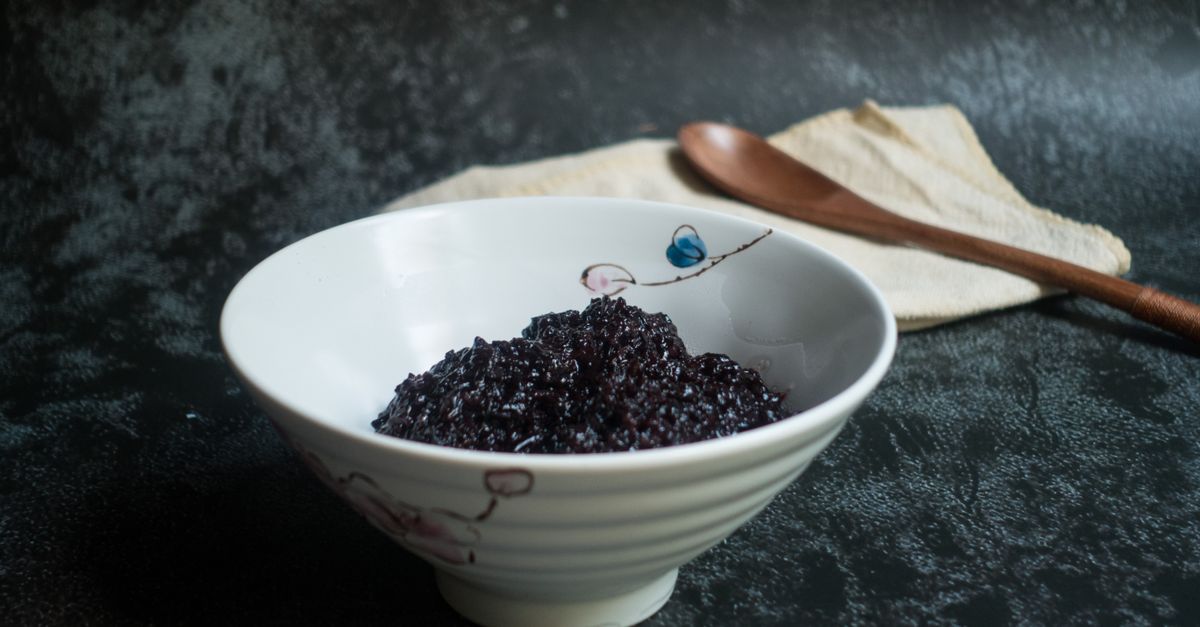
Black rice in India means, above all, Chakhao from Manipur, a GI-tagged aromatic landrace grown in kharif wetlands for 145 to 150 days. Outside Manipur and the north-east it has little verified Indian field data, so the realistic grower is in the hills and valleys of the north-east, with seed of a named Chakhao landrace and a buyer lined up before planting.
Yield is low compared with ordinary rice, and the crop is slow and tall. The case for growing it rests on identity and price, not on volume.
Where it grows in India
- Manipur: Chakhao received a Geographical Indication tag in 2020 for its aroma and colour. Its cultivation extends to about 4,500 ha and makes up around 10% of Manipur's rice production (Indian Journal of Agricultural Sciences, 2024).
- Season and field: a kharif crop that needs warm weather and a long growing period. In Manipur it is raised in wetlands, either by direct sowing of pre-soaked seed or by transplanting nursery seedlings into puddled fields.
- Nagaland trial: Nagaland University grew Chakhao Poireiton at Medziphema (310 m, clay loam, soil pH 4.85, rainfall 972 to 1,271 mm over June to November) under the System of Rice Intensification, so it also grows in the mid-altitude acid soils of the region.
- Outside the north-east: no verified trial data for the plains were found for this guide. Ask your KVK or state agricultural university before planting more than a test plot.
Varieties and landraces
| Name | Type | Traits | Notes |
|---|---|---|---|
| Chakhao Poireiton | Traditional landrace | Among the most popular Manipur black rices; tall, strongly aromatic, purple-pigmented | Reported 135 to 145 cm tall, heading in 115 to 120 days, maturing in 145 to 150 days; average anthocyanin about 740 mg per kg (ICAR-linked studies) |
| Chakhao Amubi | Traditional landrace | Black scented rice | Similar height and duration to Poireiton in a Central Agricultural University study |
| Chakhao Sempak | Traditional landrace | Black scented rice | Same study |
| Chakhao Angouba, Ching Chakhao | Local landraces | Grown in small areas for local use | Documented in a study of 93 Manipur aromatic landraces |
| RC Manichakhao-1 | Improved variety, ICAR Research Complex for NEH Region, Manipur Centre | Released in June 2025; reported to give better cooking quality and more anthocyanin | A news report says it doubles yield over traditional Chakhao; the figure is not independently confirmed here, so ask the ICAR centre for seed and trial data |
A study of 93 landraces found that the same name can cover genetically different plants, with large variation in grain type, plant height and yield between "Chakhao" samples. Buy seed only from the ICAR centre, the Central Agricultural University or a state seed agency that names the landrace, because pigment depth and aroma are what the buyer pays for.
Sowing, planting and spacing
- Date matters: in the Nagaland trial, transplanting on 15 June gave about 39% more grain than 15 July and 24% more than 30 June (pooled over 2019 and 2020). Late planting shortens the growth period and cuts tillers and panicles.
- Seedlings: the trial used 12-day-old seedlings, one per hill, at 25 cm x 25 cm (about 160,000 hills per hectare, 64,000 per acre), under SRI (non-flooded field, wider spacing).
- Fertilizer in the trial: well-decomposed farmyard manure at 7 t/ha (about 2.8 t per acre), nitrogen as urea at 50 kg N/ha (20 kg N per acre), phosphorus at 30 kg/ha and potash at 20 kg/ha as single superphosphate and muriate of potash. The trial soil was strongly acidic and low in nitrogen, so follow your own soil test (see fertilizer guidance).
- Water: Manipur growers use wetland fields, direct-sown or puddled and transplanted; the Nagaland SRI trial kept the field non-flooded. Ask your KVK for an irrigation schedule suited to your soil.
Weed control
Weeds were the main yield loss in the trial. The weedy plot gave 1.21 t/ha across dates against 2.19 t/ha with pretilachlor at 0.75 kg/ha (3 days after transplanting) followed by hand weeding at 40 days. Conoweeding twice was less effective in the non-flooded field, and pretilachlor followed by bispyribac-sodium at 25 g/ha gave the best benefit-cost ratio. Use herbicides only as labelled and on local advice; hand weeding remains the organic option.
No Indian trial data on specific pest and disease schedules for black rice was found. Blast and stem borer are general risks in rice; scout fields and take advice from the KVK or pest guide.
Yield, duration and harvest
| Treatment (Nagaland trial, pooled 2019 and 2020) | Grain yield (t/ha) | Per acre (t) |
|---|---|---|
| Transplanted 15 June (average of weed treatments) | 2.08 | 0.84 |
| Transplanted 30 June | 1.68 | 0.68 |
| Transplanted 15 July | 1.50 | 0.61 |
| Best plot: 15 June plus pretilachlor and hand weeding | 2.59 | 1.05 |
| Worst plot: 15 July with no weeding | 1.02 | 0.41 |
The crop takes 145 to 150 days to mature, so it occupies the field for most of the kharif season; plan the rotation accordingly.
Cost and returns
The Nagaland trial gives a worked example, in rupees per hectare with the trial's own cost and price assumptions. The cost of cultivation was ₹28,724 per hectare (about ₹11,625 per acre) in all treatments.
| Transplanting date | Gross return (₹/ha) | Net return (₹/ha) | Net return per acre (₹) |
|---|---|---|---|
| 15 June | 66,525 | 37,800 | 15,298 |
| 30 June | 54,206 | 25,481 | 10,312 |
| 15 July | 48,465 | 19,740 | 7,989 |
These figures come from a research farm with SRI management and the researchers' price assumptions. Your result depends on your yield, your costs and the price you actually get for aromatic black rice. No verified current farm-gate or retail price per kg was found for this guide. Check mandi bhav, local buyers and your state agriculture department, and recompute with your own numbers.
Market and selling
- Identity is the product: the GI tag covers Manipur Chakhao, so the premium belongs to genuine Chakhao grown in the GI area. Grain of unknown origin sold as black rice will not carry that premium.
- Who buys: specialty and health-food retailers, processors and exporters; confirm each buyer yourself. See export buyers. Groups of growers selling polished, packed rice usually keep more of the margin; consider an FPO.
- Risks: low yield, long duration, contamination or mixing with other rice in milling, and heavy weed pressure. Do not sign a buy-back agreement that fixes a price you have not checked against the market, and get any buyer's offer in writing.
- Subsidy: no verified rate for black rice was found. Ask the Manipur Department of Agriculture or the nearest KVK, and check the subsidy finder. For crop insurance see PMFBY.
Sources
- Dolie et al., Transplanting date and integrated weed management in SRI of aromatic black rice, Indian Journal of Agricultural Sciences 94(5), 2024
- Bhuvaneswari et al., Genetic architecture and anthocyanin profiling of aromatic rice from Manipur, Frontiers in Genetics, 2020
- Morpho-agronomic characterization of Chakhao Poireiton, Sempak and Amubi, Oryza (ICAR epubs)
- News report on the release of RC Manichakhao-1 (7 June 2025)