
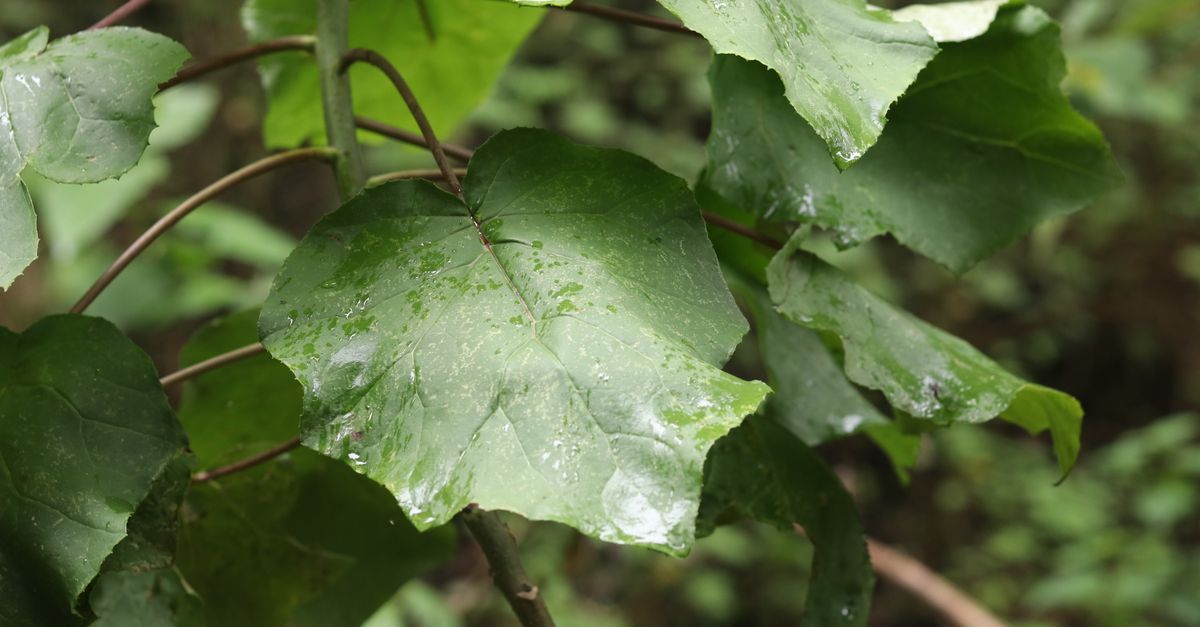
Gamhar (Gmelina arborea) is a timber tree that grows wild across much of India that grows fast on moist, well-drained fertile land and can be sold as pulpwood in about 4 to 5 years or as logs for plywood and furniture in about 10 to 12 years. It suits farmers who have fallow or bund land, can wait a decade, and have a plywood or sawmill unit within trucking distance, because there is no mandi price list for it.
Published Indian growth figures vary widely between sites, and the volume per acre you can expect depends on soil, rainfall, clone and care. Treat any brochure number of "200 tonnes per hectare" with caution and plan on local plantation records instead.
Where it grows in India
- Range: the species is native to India and is raised in agroforestry trials in Uttar Pradesh (Jhansi, Saharanpur, Prayagraj), Uttarakhand (Haridwar), West Bengal (Jhargram) and Assam (Golaghat), among other states.
- Climate: annual rainfall from about 750 mm to 4,500 mm is reported as the working range, with best growth in moist, warm areas.
- Soil: moist, fertile, well-drained sandy loam in valleys and flats. It does not do well on waterlogged ground, heavy clay, or dry sandy and poor soil, where it stays stunted.
- Wood: light timber of roughly 450 to 650 kg per cubic metre density, easy to work, used for plywood veneer, match splints, furniture, packing and pulp.
Planting material and spacing
- Plant clones or seedlings from a known superior source. Rain Forest Research Institute, Jorhat and IFGTB, Coimbatore are reported as sources of improved seed and accessions; the Assam gene-bank study found elite clones about 15 to 25% better than the population average in growth. Ask your state forest department or forest research institute which nursery is certified.
- Trials in agroforestry used 5 x 5 m (about 160 trees per acre, 400 per hectare), 5 x 4 m (about 200 per acre, 500 per hectare) and 4 x 5 m or 5 x 3 m. At Jhansi, 5 x 4 m with mungbean gave the best benefit-cost ratio of 2.67, while the widest spacing, 5 x 5 m, gave the thickest girth (27.4 cm).
- Plant at the start of the monsoon in pits dug in advance (ask your KVK for local pit size and manure), and protect young plants from goats and cattle.
Growth in field trials
| Place and system | What was recorded |
|---|---|
| Haridwar, Saharanpur, Prayagraj (4 x 5 m and 5 x 5 m, fallow land) | Best site gave a 2-year increment of 4.96 m in height and 44.5 cm in girth |
| Jhansi, UP (5 x 5, 5 x 4, 5 x 3 m with mungbean) | Tree height 6.01 m at 5 x 4 m in the study period |
| Jhargram, West Bengal (older trees with intercrops) | Volume 4.2 to 5.3 m3 per hectare per year; blackgram intercrop best (tree height 8.35 m, dbh 16.78 cm) |
| Assam gene bank (elite clones) | Growth of 15 to 25 m3 per hectare per year reported for the species under good conditions |
The gap between about 5 and about 15 to 25 m3 per hectare per year is large. A farmer on average land should plan near the lower end.
Intercrops, care and protection
- Intercrops work in the first 2 to 4 years while the canopy is open. At Jhargram, legumes (blackgram, groundnut) helped tree growth more than rice. Intercrop yields there were 1.97 t per hectare for rice, 1.03 for cowpea, 0.69 for groundnut and 0.46 for blackgram, with net returns of about ₹13,800 per hectare per year for blackgram and groundnut.
- Keep the base weed-free in year 1 and 2, prune lower branches for a clean log, and thin crowded stands. No Indian fertiliser schedule was found; follow your KVK or forest department for the soil test based dose.
- It does badly in standing water. Ask your KVK about local insect and dieback problems before using any chemical, and follow the label.
Harvest and rotation
- Short rotation of about 4 to 6 years for pulpwood and firewood; about 10 to 12 years for sawlogs and plywood billets. Girth at harvest, not age, decides the price.
- Felling and transit rules differ by state. Check with your Divisional Forest Officer before planting and before cutting whether your state requires registration of the plantation or a transit permit.
Cost and returns
- No verified Indian cost-of-cultivation table was found for gamhar. The costs are plants, pits, fencing, weeding for 2 years, pruning, harvesting and transport.
- Arithmetic to do with your own numbers: trees per acre x trees surviving to harvest (often 80% or fewer) x volume or weight per tree x your buyer's rate, then subtract total costs and divide by the years of rotation. Intercrops can offset early costs.
- One reference source gives about 1.5 to 2 tonnes per tree under good management at final harvest. This is an upper figure from a reference page and should not be used for budgeting without local plantation evidence.
Market and risks
- Buyers are plywood, veneer, match, packing and furniture units and pulp mills. There is no open mandi price, so a verbal buyer is not enough. Where possible get a written offtake before planting.
- Risks: a long wait, waterlogging losses, poor clone quality, and a thin local market. If there is no buyer within trucking distance, the crop is not worth planting.
- See FPO for group selling, KCC for credit and subsidy finder for agroforestry support. No state subsidy rate was verified.