How to Get Organic Certification in India Easily
Why Organic Certification Matters
Organic certification allows Indian farmers to market their agricultural products as “organic”, helping build consumer trust and command premium prices. It also opens doors to export opportunities and government support.
Types of Organic Certification Systems in India
In India, organic certification is governed by two major systems:
- NPOP (National Programme for Organic Production) – Overseen by APEDA under the Ministry of Commerce. Suitable for exports.
- PGS-India (Participatory Guarantee System of India) – Managed by the Ministry of Agriculture. Suitable for domestic/local markets.
Steps to Get Organic Certification (NPOP)
Follow these steps if you’re looking to export or sell at national-level organic markets.
- Select an accredited certification body
Choose from APEDA-approved certifying agencies like Ecocert, IMO, SGS, etc. - Documentation and application
Prepare farm layout, record keeping system, previous use of inputs, and submit application. - Conversion period
Typically, a 2–3 year period is required before certification to allow chemical residues to decline. - Inspection
Field audits and inspection by certification body to ensure compliance with organic standards. - Certification and labeling
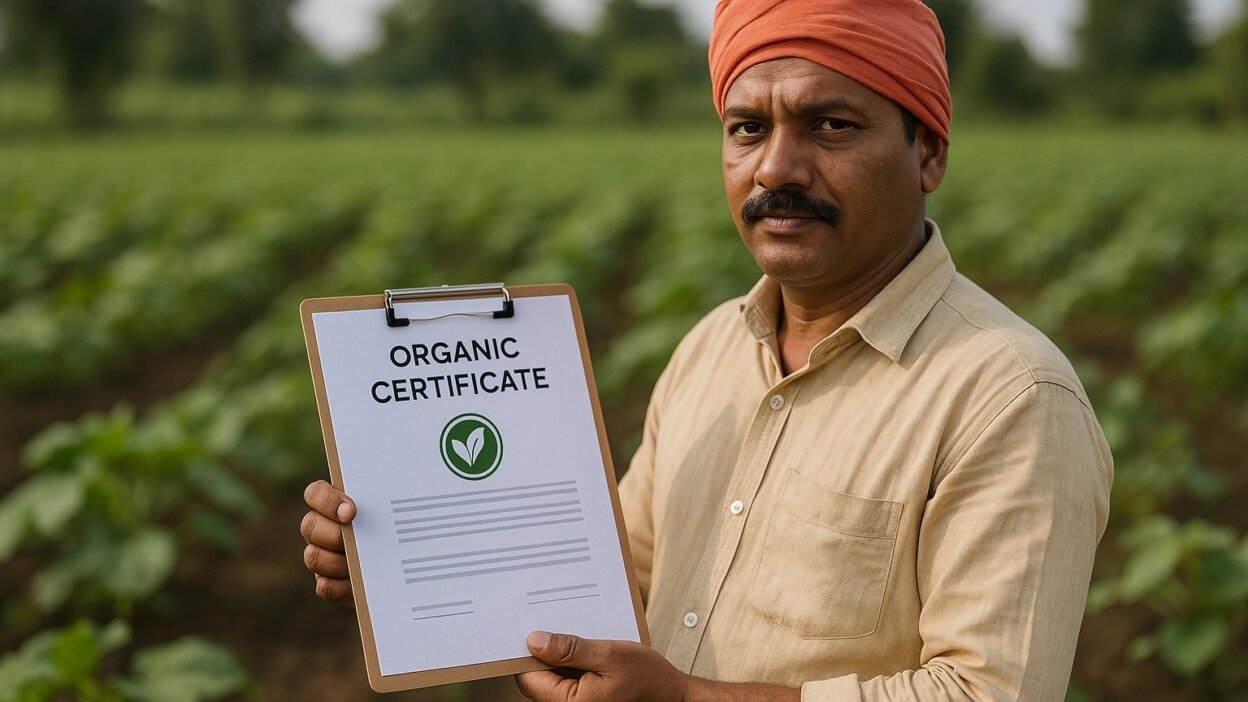
Once approved, you’ll receive a certificate and can use the India Organic logo on your produce. - Annual renewal
Organic certification must be renewed every year through regular inspection.
How to Get Certified under PGS-India
For small and group farmers selling within India, PGS-India is a low-cost and farmer-friendly option.
- Form a local group (minimum 5 farmers)
- Register with a PGS Regional Council via https://www.pgsindia-ncof.gov.in.
- Undergo internal training and peer review system
- Submit organic farming records
- Receive PGS-India organic certification
Benefits of PGS-India
- Free of cost or minimal expense
- Ideal for small and marginal farmers
- Recognized for domestic sales, local markets, and government schemes
Documents Required for Organic Certification
- Farm layout map and cropping pattern
- Farmer ID and land ownership documents
- Details of previous chemical use
- Seed and input records
- Soil and water test reports (recommended)
Government Support and Subsidies
Government of India provides financial support under schemes like:
- Paramparagat Krishi Vikas Yojana (PKVY)
- Mission Organic Value Chain Development for North Eastern Region (MOVCDNER)
Tips for Success
- Maintain detailed farm records regularly
- Avoid prohibited chemicals and GM seeds
- Train yourself and your group on organic practices
Start Your Organic Journey Today
Getting organic certification in India is not complicated—it just requires the right guidance and commitment. Whether you’re a small-scale grower or a professional farmer, adopting organic practices benefits your health, income, and the environment.
Need help getting started? Contact your nearest Krishi Vigyan Kendra (KVK) or State Agricultural Department to join PGS-India or connect with a certifying agency for NPOP certification. Grow organic, grow smart!